
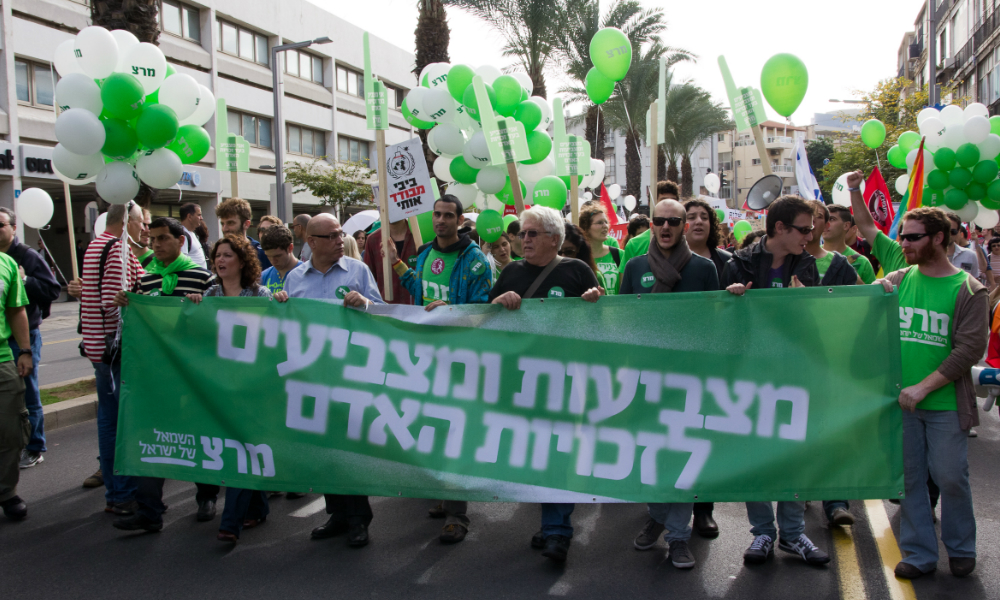
Shmuel Rosner writes in the January/February issue of Moment that the Israeli left has “vanished.” He rests his argument on statistics from two different surveys, one by the Israeli Democracy Institute (IDI) and the other his own organization, the Jewish People Policy Institute (JPPI). Rosner’s argument, all the more relevant as the election nears, is that according to the IDI survey, only 10 percent of Israelis identify as left, and that according to the JPPI, only 5 percent identify as left and 11 percent on the center-left; hence, there is no “left” for the purposes of public debate, and no serious constituency for the traditional leftist argument in favor of “peace.”
There are two critical problems with this conclusion. First, the JPPI survey cannot be used as a reliable point of reference for the simple reason that it is not representative of Israeli society. While the JPPI study surveyed only Jewish Israelis, according to Israel’s Central Bureau of Statistics (CBS), almost 21 percent of Israeli citizens are Arabs—a category which includes Arab-Christians, Muslims, and Druze — and another roughly five percent are “others” (mostly non-Arab Christians and other unclassified populations). The JPPI survey therefore excludes about a quarter of the Israeli population. The last I checked, Arabs and non-Jews are still citizens in the State of Israel. Their opinion, identity and vote matter.
Rosner’s takeaway from the IDI survey similarly ignores quite sizable populations and derives questionable conclusions. True, the survey does say that only about 10 percent of Israelis identify themselves as left. But that survey asked participants about their political identification as it related to “state-security issues.” Surely, a political identity is composed of a variety of issues, not just national security concerns. The survey also found that an additional 11 percent identify themselves as center-left, and another 27 percent say they are in the center. Aside from these 48 percent, six percent did not answer or chose not to align themselves with any of these categories. Surely a debate is warranted between 46 percent of the population who identify as right and the other 54 percent who don’t?
As Jews, we should know better than to discount the voice of the minority in any debate, and even more so in a debate that relates to one’s rights, whether religious or political. Though we may be a loud bunch, it is important to remember that even here in the United States, Jews are well in the minority. The size of the Jewish community in the U.S. depends on how one defines Jewish identity — a complex question with varying answers — but a 2016 estimate from Brandeis University puts the total American Jewish population at 7.2 million, or roughly two percent of the total American population. In the BDS debate that flares up every so often, for example, should the 98 percent of Americans of other religions take the voice of the Jewish community into consideration?
Consider another real example (not hypothetical, like Rosner’s) from Belgium: A law banning the ritual slaughter of animals was passed in the Flemish region of Belgium. The bill had broad support in the predominantly Catholic region, but it sparked outrage among the area’s Muslim and Jewish populations, who called it a thinly veiled assault on their religious freedom. Now, both of those communities combined account for less than 5 percent of Belgium’s total population, and the 30,000-strong Jewish community constitutes a mere 0.27 percent. So, does a 99.7-vs-0.3 balance warrant a debate? Does a 95-vs-5?
Rosner ends his column with a sad-but-true assertion: The upcoming Israeli elections are not going to be about peace. That’s because the word “peace,” the concept it represents and its supporters have all been slowly pushed to the outskirts of Israeli consciousness. In light of a handful of military “operations” and 2011’s Social Protest, the topics of security and social justice have taken center stage in Israeli discourse. As of now, Israelis have been left with no justice, no security, and no peace.
Before deciding whether the left in Israel exists, it’s important to ask: What are “the left” and “the right”? I would argue that this is a tricky division to make anywhere, and even more so in Israel.
In the past, leaders of the Israeli left have been responsible for many supposedly right-wing maneuvers, most prominently the beginning and unabated expansion of Jewish settlement beyond the 1967 borders. Currently championed by the right-wing establishment, this policy was formulated under Labor founder Levi Eshkol and supported through the tenures of Golda Meir, Yitzhak Rabin and others. On the flip side, prominent right-wingers such as Menachem Begin and Ariel Sharon have been the ones to make the most outstanding concessions to Arab neighbors (returning the Sinai to Egypt and initiating the unilateral disengagement from Gaza, respectively). In large part, these idiosyncratic actions came from an understanding all of these leaders shared: that the security of the State of Israel comes first.
After a decade in office, Prime Minister Benjamin Netanyahu and his ilk have created an environment where right-wing narratives dominate the discourse. But countless historical examples show that whether they identify as left or right, Israelis and their leaders have always known to put the country’s interests above their own. Finding a government and a prime minister capable of doing just that is what the upcoming elections are about.
Anis Modi is Moment‘s Rabbi Harold S. White Fellow. (photo credit: Amos Ben Gershom/GPO)