
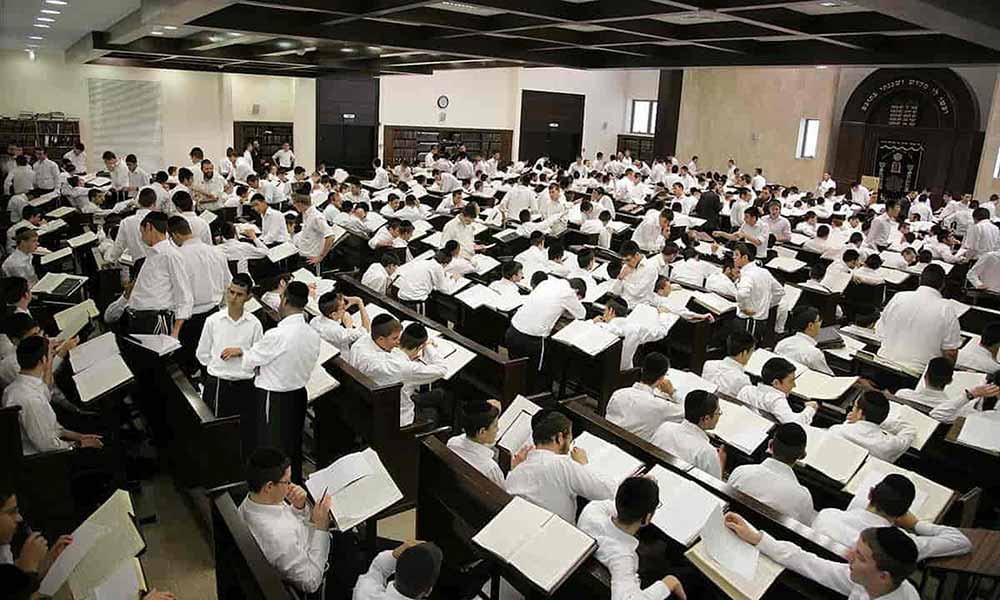
Like the misguided heroes of some Greek tragedy, Haredi leaders and educators in both the United States and Israel are waging battle to defend, as they see it, their way of life. The hateful foes: state oversight of schools and their children’s right to more than the meanest scraps of a modern education.
We now know in detail, thanks to The New York Times’s investigative journalism, that some Hasidic schools in New York are hubs of cultural separatism, core-curriculum evasion and state-finance siphoning. One such school just pled guilty to fraud charges and agreed to pay an $8 million fine. This comes as no surprise to Israelis. Much of our Haredi school system (there are a few exceptions, mainly high-end girls’ schools) is a far larger piece of the same fabric, complete with Education Ministry personnel “keeping an eye shut” on the institutions they are supposed to supervise. Israeli taxpayer money flows to schools for nonexistent students and ghost educational programs. The misery of Haredi dropouts who left their community unequipped for modern life and jobs is heart-wrenching in both countries. The personal stories of ex-Haredim who battled and overcame their educational impediment are similarly inspiring.
Israel’s “independent” education sector—this official name sycophantically ignores its near-total dependence on state funds—has existed since the birth of the state, but its demographic has doubled and tripled over time. By 2050, if current population trends hold, up to a third of Israel’s Jewish pupils will attend Haredi schools. The vast majority of these schools currently teach nothing outside their own culture: no history, geography, civics, language or secular literature, even in Hebrew. Female students may have access to some basic math and English, most boys not even that.

This is bad enough. Yet the core curriculum of modern school systems was never only about economic success. Had it been so, math and English might be enough (albeit on a far higher level than is taught). Good education must also include world history and geography, but most Haredi schools do not even teach Jewish or Israeli history as such. Their students receive zero information about our planet, its climate processes, its political systems and major debates—not to mention study of the human body and human emotions.
The issue played a significant role in November’s elections. The Rabbi of Belz, one of Israel’s most important Hasidic leaders, announced that his own congregation’s children will henceforth study a (carefully curated) math-and-English limudey liba, or core curriculum. One purported motive was financial: Israeli schools that teach the core curriculum are better funded by the state than those that don’t.
The ensuing storm was a dramatic one even for the storm-ridden Haredi world. For most Haredi leaders, even English and math—let alone modern history or Hebrew literature—spell a great threat to schoolboys’ pre-paved road to a life of full-time, full-mind Torah study. No wonder the Belzer rabbi’s decision ignited an inner conflict, threatening to dissolve or weaken the all-Haredi party Yahadut Ha-Torah (United Torah Judaism), a crucial partner to Benjamin Netanyahu and Likud’s bid to return to power.
Many Haredim, especially women and the young, were apparently fascinated by this first significant crack in their educational sector’s wall of faith-inflicted ignorance (as conveyed by numerous hints in the coverage and a few courageous online statements). Many non-Haredim, both religious and secular, openly rejoiced, as did Israel’s universities, which might now expect more and better-prepared Haredi candidates. However, the joy was short-lived.
Netanyahu’s secret election promise to the Haredi leaders, exposed by The Marker journalist Merav Arlozorov, was simple: Under his future premiership, all schools, whether they teach the core curriculum or not, would receive the same state financing. As secular liberal critics were quick to observe, Netanyahu has no qualms about selling the professional future of undereducated Haredi boys and girls in exchange for their rabbis’ and leaders’ support for his political comeback.
At press time, it was not clear yet whether the Bibi-comeback would succeed. If it does, the ultra-Orthodox educational system can continue to dodge math, English, humanities and sciences with the state’s blessing. Perhaps. But, as my late father used to say, other clocks are ticking too.
I was deeply impressed by The New York Times’s act of cultural subversiveness in making its full report on the New York schools available in Yiddish. Haaretz also reprinted it in Hebrew, ensuring it will be read deep in the Haredi bastions of Bnei Brak, Jerusalem, Beit Shemesh and Beitar Illit. If New York authorities truly stop evading the issue and demand curriculum changes in state-assisted Hasidic schools, Israeli Haredim will be watching very carefully.
For now, progressive-minded Israelis and education-hopeful Haredim must brace for backlash. Yahadut Ha-Torah’s new parliamentary leader, Yitzhak Goldknopf—appointed, like his predecessors, by the highly influential Rabbi of Gur—is a traditionalist hardliner. He’s also a media novice: He told the press, during a tense week when three IDF soldiers and several Palestinians were killed, that yeshiva students “killing themselves in Torah’s tent” make a greater sacrifice than soldiers protecting the country. The sentiment is old, but the timing added insult to injury, as did Goldknopf’s amazing subsequent statement that “[the study of] mathematics has not promoted [the] Israeli economy.”
In the meantime, most Haredi-owned websites in both Hebrew and English gagged all further news of the New York Hasidic school controversy in a belated attempt to shut the gates. But the internet has no walls. From outside and from within, times may finally be a-changin’.
Fania Oz-Salzberger is an Israeli essayist and professor emerita of history at the University of Haifa.