
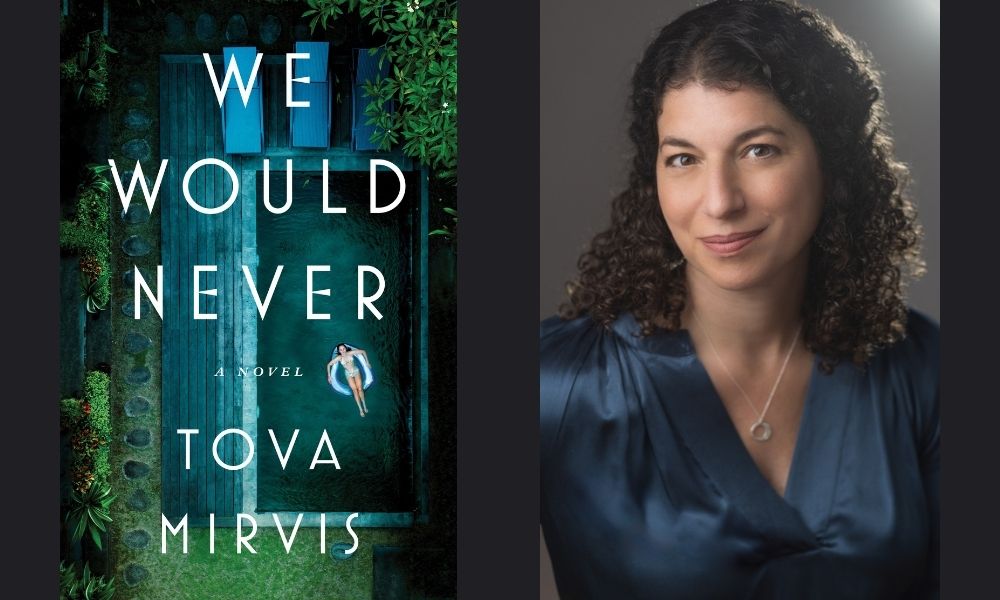
We Would Never
By Tova Mirvis
Avid Reader Press 368 pp
Tova Mirvis doesn’t consider herself much of a “true crime person,” but when a friend of her ex-husband was murdered in 2014, she became obsessed. She read every news article she could find about the murder-for-hire of the Tallahassee law professor whose ex-wife’s family was ultimately implicated in his death.
The dramatic facts of the case, which inspired a podcast and a Dateline episode, made it hard to ignore: A divorced couple, both lawyers from seemingly close-knit Jewish families, spar over custody. The ex-husband obtains a court order barring his ex-wife from moving their young sons from Tallahassee to her hometown nearly 500 miles south; not long after, he is killed. Over the next eight years, his ex-brother-in-law and three accomplices are convicted on murder and conspiracy charges and sent to prison. The case has yet to be fully solved: His ex-mother-in-law’s trial on charges of murder, conspiracy and solicitation to commit murder is scheduled to start later this year.
Chasing down info about the story became Mirvis’s go-to form of procrastination when she needed a break from writing her 2017 memoir, The Book of Separation, which was in part about the end of her own marriage.
Even after the memoir was complete and she began working on a new novel, she couldn’t stop thinking about the murder. So she set aside the novel-in-progress and started a new one, We Would Never, a page-turning whodunit about a seemingly close-knit Jewish family in Florida who conspire to commit murder when a custody battle turns ugly. The bones of the story are ripped from the headlines, but Mirvis used her imagination to flesh out other details, such as geographical locations and the characters’ names, occupations, motivations and inner lives.
In a recent conversation with Moment, Mirvis talked about the inspiration for the novel, the challenge of creating empathetic murderers and the importance/difficulty of keeping a clear distinction between the real victim and her fictional one.
Why do you think you were so captivated by this case?
I had a very tangential connection to the victim and was friends with him on Facebook. I started to see Facebook messages informing friends that this man had been murdered, sharing and lamenting the news. The initial news coverage speculated that he had been murdered by a student who was upset about a bad grade, or maybe a colleague who disagreed with his theories on constitutional law. And the last line of a news article I was reading said that he had been through a very contentious divorce. I had also been through a contentious divorce, and I just had that feeling—like, “Hmmmm…Legal theory? I don’t think so.”
Reading, listening to a podcast and watching a Dateline episode about a murder requires a time commitment, but not the same commitment as devoting six years to writing a novel about a murder. What motivated you?
I could Google it and Google it and Google it and it turned up so much information, but nothing gave me what I wanted to know. Nothing answered my question of How does a family do such a thing? How do you go from being a seemingly normal family in Florida to doing something so unimaginable? I felt like I could read the news all day long, and nothing was going to answer the question for me. It wasn’t the facts of a crime I wanted, it was their inner lives—I wanted to see a piece of their souls. And the news media was not going to give me that. And I was frustrated. I just felt like it was something I needed to understand about how events escalate, how divorce unmoors people from who they are—how families, with all their usual enmeshments and complications and pain, can veer off and lose their moral compass and do something so unimaginable.


Although true crime led you to this story, when it came to writing about it, you approached it as a novelist. Why?
Only novels let us have access to the inner life in that way. Only novels give us that glimpse of the soul, that inside of someone’s experience: What do they think about when they can’t fall asleep at night? What are their demons? What do they wrestle with? What do they want? I decided to think about it not as a true crime story or a tabloid story, but as a literary novel about family, and how families unravel.
How much of that story echoes the actual case?
It uses a lot of the same elements, but in the real story the details of the divorce are completely different. And Jonah, the murder victim in the novel, is not at all intended to be based on the real victim in the true case. I invented Jonah as a character separate from the real person.
You said that you knew the real victim as outgoing, warm and vivacious. Why did you make your fictional victim, Jonah, cold and condescending?
The character of Hailey, Jonah’s wife, was warm and sunny and bubbly. I wanted Jonah to be the opposite. I was interested in his overconfidence. Hailey struggles with her confidence—is she smart enough, is she good enough? In a divorce, two stories take shape. We see Jonah more or less only through his in-laws’ eyes, and point of view is everything. If I had chosen to view the events of the novel from Jonah’s point of view, they would look a lot different. I played with that question of “The nicer he seemed, the more awful they seemed, and the nicer they seemed, the more awful he became.” I wanted it to be almost a seesaw.
Hailey’s mom, Sherry, evokes some sympathy in the reader. She’s clearly devoted to her family, or her idea of her family. But then she conspires to have her son-in-law killed. She’s supposed to be such a family person, but she has no qualms about depriving her only grandchild of a father. Are readers supposed to see her as a meddling mother or a mother who loves her children so fiercely that she doesn’t always have boundaries?
I was interested in the question, “Can you love too much? Is there even such a thing?” and what happens when you do. For so many years, I wrote with small kids running around. Now that my kids are older, I understand anew the fear of your kids going out in the world. I don’t think I’m an overbearing mother—I do think my kids will back me up on that—but I do understand the anxiety you could feel when kids grow up, the urge to hold them close, to keep them home. Yes, [Sherry] is a little enmeshed, but she loves her family. I feel like you can make the case for everyone’s humanity, even as they do things that are inhumane, even as they do things that you disagree with so strongly as a reader and as a writer.
How big a challenge was it for you to write the characters without judging them?
I wanted to write from the family’s point of view, and to write from their point of view I had to write from their humanity. The idea that “Oh, they’re monsters” is not a compelling idea to me. Yes, they go down an unimaginable path, but I couldn’t let go of the sense of their humanity in writing about them, which we’re so quick as a society to do: We’re so quick to judge and blame and hate.
Is that where the title comes from? Because that’s what a lot of us think when we rush to judgment, although it’s more of a first-person singular, “I would never…”
I do think about the idea that everyone is so certain they’re right that no one can hear any other point of view. One of the things I’ve thought about in writing this book is, although I’m asking you to enter into the point of view of this family, it doesn’t mean you endorse them. It doesn’t mean you agree with them. I’m not interested in whether you think they were right to do this. Of course they weren’t. It’s such a horrific thing that they do. But could you imagine it? Can you imagine the possibility?
What did it take for you to imagine that possibility?
I love a Vivian Gornick quote, “For the drama to deepen, we must see the loneliness of the monster and the cunning of the victim.” That idea, the loneliness of the monster, is one of my guiding principles as a novelist. I have to see all parts of people. I have to be willing to enter into all the stories. What I love about writing fiction is that it feels like a life of imaginative empathy: “What is it like to be you? What is it like to be these people?”
When you’re inspired by a real-life event, you have something of a template available to you. As you pointed out earlier, you can’t know exactly what people are thinking, but you get some sense of it from reading about them. What were some of your takeaways from the actual case?
One of the things that baffled me for so long about the case was that no one was willing to back down. In the custody battle that took place both in real life and in my book, I just felt like, why is no one willing to find a way to relent or to bend? Everyone holds fast to their certainty that they’re right and no one is able to forge compromise. In the absence of compromise, in the absence of any kind of forgiveness, there’s such destruction for these families, for so many people. It felt unbearable to think how many people’s lives were destroyed by this action, including their own. They destroyed themselves, ultimately.
Top image: Tova Mirvis (Credit: Sharona Jacobs).
“Moment Magazine participates in the Amazon Associates program and earns money from qualifying purchases.”