
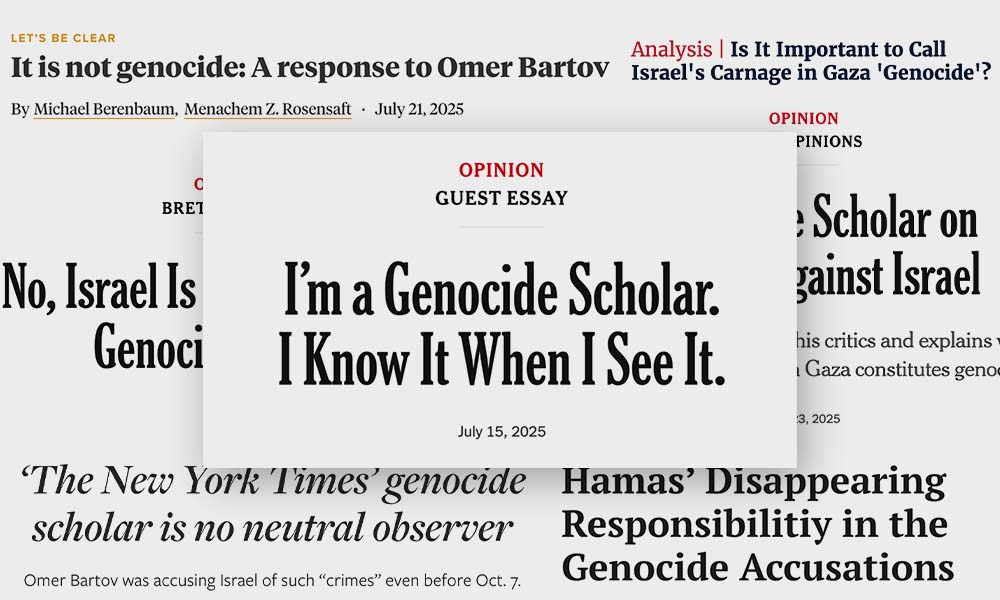
Holocaust historian Omer Bartov started quite a conversation when The New York Times op-ed page published his essay “I’m a Genocide Scholar. I Know It When I See It.” In 3,500 or so words, Bartov, a professor at Brown University and the author of many books about the Holocaust as well as a novel based on the massacre of his own family in World War II Ukraine, argued that although early in the war that started October 7 he had not considered the IDF to be perpetrating a genocide in Gaza, he has changed his mind. It may not have started out that way, he writes, but the continuation of slaughter after Hamas ceased to be “an organized military body,” with the “intention” expressed in intemperate statements made by right-wing Knesset leaders—especially shortly after October 7—forces an inevitable conclusion: “Israel’s actions could be understood only as the implementation of the expressed intent to make the Gaza Strip uninhabitable for its Palestinian population.”
Unsurprisingly, the essay has produced the kind of din of discussion that an opinion page is supposed to generate, with waves of attention and heated debate on social media and a flurry of TV and radio interviews—including a follow-up interview this week in which Daniel Wakin, Times international opinion editor, pressed Bartov on many of the points critics have offered in rebuttal.
And of course, within the Jewish community, those rebuttals are flying fast and furious. Some are detailed counter-arguments by other scholars of genocide or of Holocaust history, addressing Bartov’s points in the language of the field. Others are more concerned with attacking Bartov’s credibility or dismissing him as an anti-Israel propagandist, a difficult task given that aside from being a Holocaust scholar, he grew up in Israel and served in the IDF.
The argument over the word “genocide” is of course in many ways a sideshow to more concrete questions, such as how to end the war and what is actually happening to the food in humanitarian aid convoys.
In the scholarly category, Jeffrey Herf, a professor emeritus of German and European history at the University of Maryland, argued in a Times of Israel blog post that to accuse Israel of genocide in Gaza is to ignore “the disappearance and repression of the agency and responsibility of Hamas for launching a war of extermination, and then for fighting the resulting war with a strategy intended to maximize death and suffering in Gaza.” Aside from the questionable nature of casualty statistics from the Hamas-run Gaza Health Ministry, Herf writes, “none of those casualties would have occurred had Hamas surrendered long ago. If Hamas were to surrender, the war, and suffering would end immediately. Here as well, repressing the agency and actions of Hamas is central to Bartov’s argument and the genocide accusation.”
Historically, Herf adds, “describing Israel’s wars of self-defense as examples of genocide” echoes perennial themes of propaganda from the Soviet Union onward.
Two other prominent scholars, Michael Berenbaum and Menachem Rosensaft, strike similar themes in a piece co-written in E-Jewish Philanthropy, while also addressing the legal side of the genocide accusation (Rosensaft has taught about the law of genocide at the law schools of Cornell and Columbia). They note that although the assertions by some Israeli government officials after October 7 were horrific, they did not constitute “intent” to commit genocide in the legal sense for actions that were in fact taken for military reasons.
In the Times’s own pages, columnist Bret Stephens took on the Bartov piece more broadly, arguing that if Israel actually had the intent to commit genocide of Gazans, the casualty figures would be much higher, and he adduced examples of similar military campaigns that produced horrific slaughter without being tarred as genocide—such as the U.S. campaign to retake Mosul from ISIS in 2016-17 and the World War II Allied bombings of Hamburg and Dresden. As for the statements by Knesset members that Bartov pegs as suggesting intent, Stephens writes, “furious comments in the wake of Hamas’s October 7 atrocities hardly amount to a Wannsee conference.” Stephens also worries that the tendentious use of the term “genocide” will “dilute the meaning of a word we cannot afford to cheapen”—an interesting twist on Bartov’s own concern that Holocaust education could become difficult or impossible once Israel has itself perpetrated a genocide, hollowing out the moral force of the cry “Never again.”
Not all the rebuttals of Bartov’s piece take the high road. There’s a whole universe of reflexive side-takers who have posted or written articles assailing Bartov either by seeking to paint him as an antisemite or an opportunist (again, a difficult task given his background and bona fides) or asserting that all the evidence he cites is Hamas propaganda. (Thane Rosenbaum in the LA Jewish Journal even avoids mentioning Bartov by name, instead fulminating against an unnamed “genocide ‘scholar’” who teaches at Brown.) Then there are the bloggers, Substackers, magazine editors and others who have been arguing all along that any and all accusations of genocide proceed out of antisemitism and have nothing to do with the facts on the ground, which in any case they contend have always been misreported. Some note that accusations of genocide are meaningless because they have been continually made since October 7, even before Israel launched its defensive war. Moshe Phillips of Jewish News Syndicate characterizes Bartov as a long-time anti-Israel polemicist, dismissing his IDF background as just another form of “as-a-Jew” posturing. “Let’s be clear: Bartov’s problem is not what is happening in the Gaza Strip. His problem is Israel’s very existence,” he writes, offering as evidence that Bartov signed a letter even before October 7 accusing Israel of “conspiring to ethnically cleanse all territories under Israeli rule of their Palestinian population.” Andrew Koss of Mosaic Daily calls Bartov “a once-serious scholar who knows better, and who has been chomping at the bit to accuse his country of genocide since November 2023.”

The argument over the word “genocide” is of course in many ways a sideshow to more concrete questions, such as how to end the war and what is actually happening to the food in humanitarian aid convoys (and, in the week since the Bartov piece, the increasing focus on possible starvation in Gaza). But it packs a punch because it operates as a proxy for fundamental questions of legitimacy and moral authority. Those insisting on the word “genocide” charge, in a variety of codes, “Israel, the story has changed—you’re the villains here.” Those opposing it plead, “We’re not the bad guys.” For both the pro-Palestinian and the pro-Israeli sides of the argument, the word is appealed to as an argument-ender: If one side has committed genocide, nothing else matters.
Interestingly, the converse—that if it isn’t genocide, nothing Israel has done can be condemned—is rarely asserted. Many of those who argue against the applicability of the word “genocide” are sharply critical of the war in other terms. Bret Stephens stipulates in his essay that the destruction in Gaza “is indeed immense” and that “There are important questions to be asked about the tactics Israel has used,” particularly surrounding food distribution. Berenbaum and Rosensaft likewise note, “We are not arguing that this war has always been waged appropriately or that it has been waged proportionally.” In dismissing the idea that statements by “certain far-right, not to say neo-fascist, Israeli officials whose language could well be considered genocidal” constitute legal evidence of genocidal intent, they stipulate, somewhat awkwardly, that “We, the authors of this article, have held high positions within the Jewish community, and we have a clear and consistent record of condemning such statements.” Other thoughtful takes have included scholar Shaul Magid’s meditation on whether Jews are engaging in “Neroism”—debating terms being a way of fiddling while Rome burns.
One final group of commenters, best exemplified by Haaretz’s Dahlia Scheindlin, steps back and suggests that the whole argument is a distraction from talking about realities on the ground, similar to the debate over the word “apartheid” a decade ago. “Why are we having this conversation?” her piece concludes. “If the word genocide haunts you, what should be haunting you is Gaza.” Regardless, it’s a word and a debate that are both likely to go on haunting us for some time.
2 thoughts on “Is It Genocide? Omer Bartov Sparks a Furor”
Thank you so much for this run-down of Bartov’s piece and the various responses to it. I’ve been somewhat avoiding or ignoring this painful debate (maybe that puts me a little in Scheindlin’s camp), and so I had not had the opportunity to read Bartov’s essay. I decided to do so before reading your piece.
Now that I feel a little more informed about who said what, I’m still not convinced that the definition of genocide has been met in Israel’s war against Hamas. But that seems less important than what the existence of the debate means. The fact that accusations of genocide and ethnic cleansing were made even prior to Israel’s response to the Oct. 7th massacre, and that they continue to gain steam despite the many facts which run counter to such claims (many of which Bartov, himself, acknowledges) is hard to understand as anything other than pre-existing, deep-seated animus toward the only Jewish state in the world. There is no precedent I can think of in this century, and even since WWII, for how Israel and Israelis are being treated – to say nothing of the way Jews around the world are being stigmatized and held communally responsible for the situation in Gaza; and there have certainly been cases far more clearly and universally labeled as “genocides” than this one. I think it’s fair to say that nothing like this reaction has ever seen with any other national or ethnic group.
It’s a mess. There is definitely room for criticism of some of the statements of Israeli officials, and there is plenty of reason to scrutinize Netanyahu’s handling of the war. But a war it is. And it should be discussed and assessed as such.
Read war expert John Spencer’s assessment of Bartov. Bartov is a liar, a fraud, and, in my opinion, a head case.
https://www.jns.org/im-a-war-scholar-there-is-no-genocide-in-gaza/