
“B’Ivrit: A Hebrew Language Media Roundup” is a monthly look at the news through the eyes of Israeli media consumers.
1. Drinking L’chaim in the TV studio
It was an odd, yet very telling, moment on Israeli TV.
Channel 12’s top political commentator Amit Segal, hosting Meet the Press, one of Israel’s most-watched news shows, took out a bottle of arak— a Middle Eastern alcoholic beverage in the anise family—and a few paper cups and offered the distinguished panelists in his studio a shot. The reason for this unusual gesture on prime-time TV was to celebrate the successful Israeli assassination of Hezbollah leader Hassan Nasrallah. Before raising his glass, Segal quoted Judges 5:31: “So let all thine enemies perish, O Lord.”
Some around the table seemed a bit uncomfortable, but all raised their cups and drank. Segal’s co-host Ben Caspit, perhaps feeling the inappropriateness of Segal’s celebration, added that he is drinking for the release of the hostages. Another panelist suggested it may be too early to celebrate.
The next day, Segal responded to critics who felt uneasy with his l’chaim by posting historic photos on X of Americans and Europeans celebrating the news of Hitler’s death.
Raising a glass of arak in the TV studio may sound extreme, but it is fully in line with the response of all Israeli news outlets following Friday’s military operation against the Hezbollah bunker in Beirut, which killed Nasrallah and at least 20 other top Hezbollah commanders.
A year into the war, it is safe to say that the Israeli press has given up on the idea of reporting from the sidelines. Instead, the media is now first to lead the cheers when news of battleground victories arrives, and it is also there to set the tone when tragedy hits. There’s nothing wrong or surprising about it. Journalists in Israel, just like any other Israelis these days, hope for their country’s success and grieve with its loss. This lack of boundaries can lead to a table full of respected journalists and analysts drinking shots of arak in the studio to celebrate the death of their enemy.
2. How the story played out
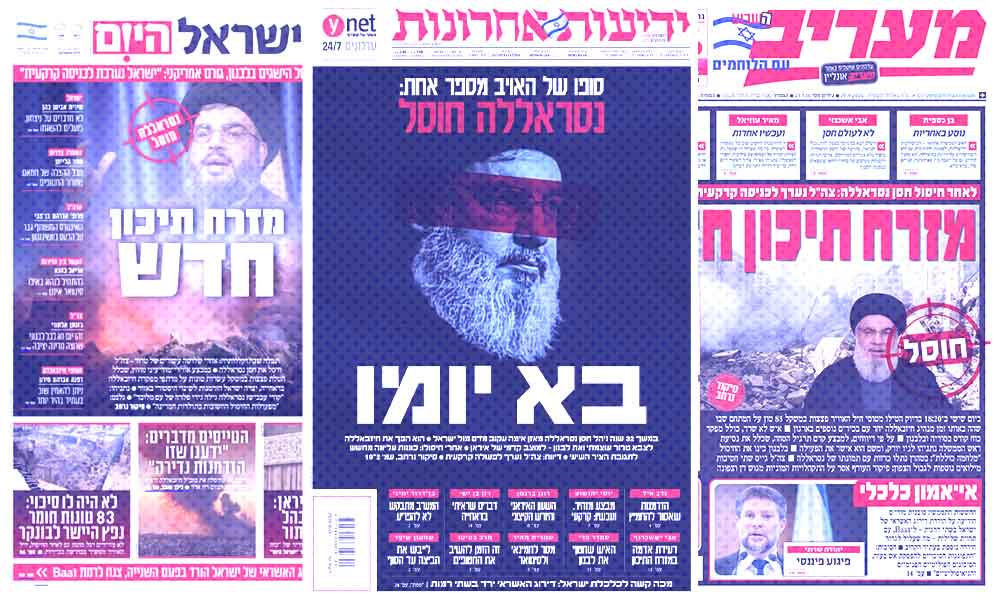
“His Day Has Come,” announced the headline of Yediot Ahronot, Israel’s largest centrist newspaper, over a full-page photo of the late Nasrallah. “A New Middle East,” exclaimed Israel Hayom, the nation’s popular right-wing daily. An image of smoke rising from the bombed Hezbollah compound and another of Nasrallah in crosshairs served as a backdrop for this headline. Editors at Maariv, a center-right daily, chose the exact same wording for their headline “A New Middle East,” perhaps hoping too, that the death of Nasrallah somehow assures a bright future for the region. The front-page article detailed the military operation in which the Israeli air force dropped 83 one-ton bombs on Nasrallah and his colleagues and the decision-making process in Israel that preceded the attack.


The celebratory mood swept almost all Israeli media outlets. Coverage included astonishment at the unparalleled intelligence that enabled pinpointing Nasrallah and endless praise for what was described as an exemplary operation by the pilots who carried out the bombing mission.
Minutes after the news of Israel’s Beirut attack broke, TV news channels shifted into 24-hour breaking news mode, reporting on the operation, pulling out archival material about Nasrallah’s long history of terrorism, and providing hours and hours of studio analysis from military experts trying to guess what happens next.
Almost all chose to ignore questions raised around the world regarding the strategic wisdom in taking out Hezbollah’s leader, or suggestions that Israel should use this military feat to advance the goal of ending the war with an unquestionable victory. The Israeli media was too busy basking in the IDF’s success and framing it as the ultimate assertion of Israel’s invincibility. Watching the news from Israel these past days could lead to one clear conclusion: The shame of October 7 has been erased. Israel is once again the greatest military power in the region.
3. The terms we use
It’s worth taking a moment to look at the terminology used by the Israeli media.
The killing of Nasrallah, and for that matter any terror operator, is described in the Israeli press with the term “choslu,” or “elimination.” The term has taken over the airwaves: Nasrallah was eliminated; Israel eliminated Hamas leader Ismail Haniyeh; Israeli forces eliminated three Hamas terrorists in Rafah, and the list goes on.
The term “elimination” to describe the killing of an enemy, whether as a planned assassination or during combat, originated in military jargon and has been fully adopted by Israel’s Hebrew-language press.
There is, of course, a good reason for that. Elimination suggests getting rid of a problem, of a danger. It implies that the action taken is positive and will lead to a better future. Other possible terms, such as simply calling the act “killing,” bear a negative connotation and could raise questions regarding the value, legality or morality of the action.
Make no mistake, Hassan Nasrallah, one of the most dangerous terrorists of our times, was indeed a clear and present threat to the lives of every Israeli, as well as many Lebanese, Americans and others who might have crossed his path. The killing of Nasrallah indeed eliminated a threat, and calling it an “elimination” makes good sense. Is that the case with all enemy casualties? Probably not.
4. Did Bibi deceive Hezbollah—or the press?
While Israeli pilots were on their way to Beirut to carry out the killing of Nasrallah, Prime Minister Netanyahu was in New York, delivering his speech at the United Nations General Assembly. Minutes after he got off the podium, during a briefing with Israeli reporters, Netanyahu’s military adviser tapped him on his shoulder and whispered something in his ear. Netanyahu left the room abruptly. Moments later, the world learned that Israel had just killed the leader of Hezbollah.
The Israeli press worked hard to provide a play-by-play recreation of the days and hours leading up to Netanyahu’s dramatic decision. Hand fed by Netanyahu’s advisers, reporters shared a photo of Netanyahu giving the final okay, hunched over a secure phone in his New York hotel before leaving for the UN headquarters. The Israeli press also reported how Netanyahu’s entire visit to New York was actually a brilliant ploy to set Hezbollah off track, since they’d never suspect Israel would carry out such a brazen attack when the prime minister was out of the country.

It was an exciting explanation, and one that fit well with Netanyahu’s PR battle against his critics in Israel who claimed he should not have traveled to the UN General Assembly while his country is at war. Almost all media outlets ran with the story—attributed only to “sources close to the prime minister”—describing Netanyahu’s masterful deception.
It was a great story. But it wasn’t true.
With some further reporting, it became clear to reporters that they’d been fooled. Netanyahu, in fact, did not know before leaving for New York if and when the operation would take place. Netanyahu did not leave for New York in order to deceive Hezbollah. He simply thought it would be a good idea to address the UN in person, even if it meant leaving behind a nation at war for 48 hours.
5. A look from the Haredi side
Media outlets aligned with the ultra-Orthodox groups in Israel also joined the celebration over the killing of Nasrallah, but in their own unique way.
Yated Neeman, one of Israel’s leading Hebrew Haredi publications, led with the story of Nasrallah’s killing, adding in its headline that Israel “cut the head of the snake.” A front-page above-the-fold commentary column, however, explained to the ultra-Orthodox readers, many of whom do not serve in the military, that “one should not be mistaken to think that the military might and power are our protectors. Our only protector and defender is our holy Torah.”

Hamevaser, another Haredi publication, combined in its headline the two narratives: “With God’s grace: Arch-terrorist Hassan Nasrallah has been eliminated.”

One thought on “B’Ivrit | The Elimination of Hassan Nasrallah”
This excellent report is consistent with the quality that I have come to expect from Moment.