
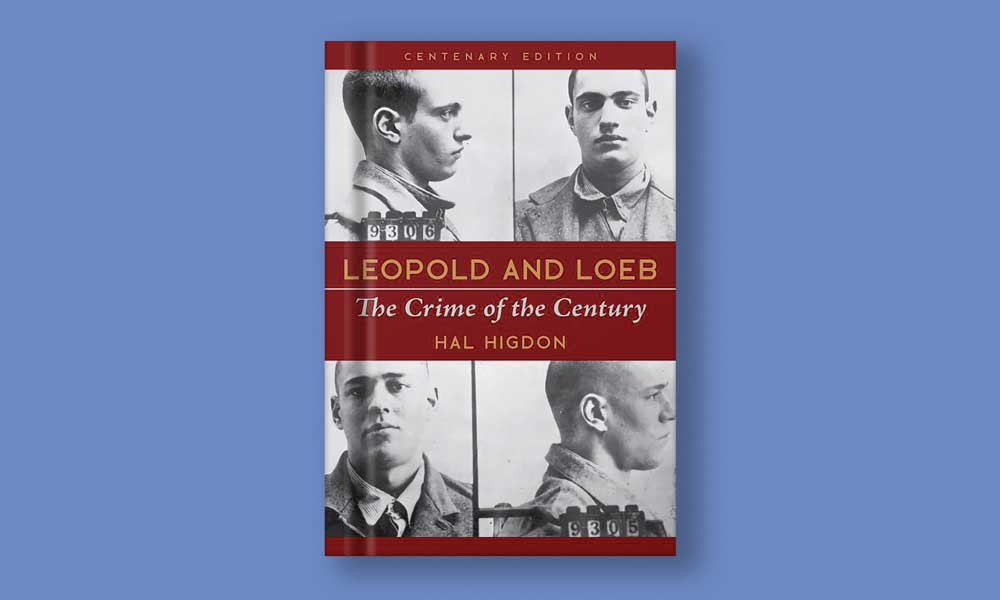
Leopold and Loeb: The Crime of the Century Centenary Edition
By Hal Higdon
University of Illinois Press;
384 pp.
I was recently binge-watching the Netflix series Better Call Saul when one allusion in the dialogue triggered long-dormant memories. The hero and heroine were confronted by a former colleague whom they were in the process of defaming and destroying professionally through a series of baroque schemes ranging from pranks to outright felonies. “Why?” the victim asked. “What justification makes it okay?…I thought you did it for the money but now, it’s so clear. You did it for fun. You get off on it. You’re like Leopold and Loeb. Two sociopaths.”
I can’t imagine that many Netflix viewers under the age of, say, 60 got the reference. In fact, it had been decades since I heard the names of Leopold and Loeb. They were the subjects of Meyer Levin’s 1956 novel Compulsion (with their names but little else changed), which was made into a movie with the same title in 1959. I was 12 that year, and in the days before movie ratings, my parents (who owned the book) decided the movie was too disturbing for me to watch.


Baby Boomers grew up hearing about the two intellectually precocious, rich Chicago teenagers who plotted what they intended to be a “perfect crime” back in 1924. A key element of its ostensible perfection was that the victim would be chosen at random on the day of the crime. Any physically small, and therefore manageable, younger rich boy from their neighborhood would do, provided the boy’s father was likely to pay a ransom. (According to the plan, he would pay it without knowing that his son was already murdered.) Jewish Baby Boomers like me probably grew up hearing somewhat more about Richard Loeb and Nathan Leopold Jr. because they were two intellectually precocious, rich Chicago teenagers who were also Jewish.
The case was dubbed “The Crime of the Century,” which became the title of Hal Higdon’s 1975 nonfiction book, now being reissued as we near the vantage point of a literal century since 1924. The case was not a thriller. The body of Leopold and Loeb’s victim, 14-year-old Bobby Franks, was discovered before the ransom was paid. A pair of glasses found near the body was linked to Leopold. The two were arrested, interrogated and charged with the kidnapping and murder, to which they pleaded guilty. What was erroneously called their “trial” was, in fact, a sentencing hearing addressing a single question: Would the boys hang or spend their lives in prison?
The judge (there was no jury) chose prison. Loeb was serving his sentence when he was murdered; Leopold was paroled after 33 years and after volunteering in a malaria test.
The reissuing of Higdon’s book poses an interesting question about sensational crimes and courtroom dramas that dominate mass media and public conversation for months on end: Were they worth all that attention? Was anything there beyond lurid sensation and titillation? In this case I would say yes. Higdon’s deeply researched book conveys a sense of ideas in the wind in 1920s America, ideas that were called to the fore by the terrifying case of a random thrill killing.
Leopold and Loeb, respectively 18 and 19 when they committed the crime, had already finished college. Leopold’s IQ was over 200; Loeb’s was 160. Leopold was physically slight, an accomplished linguist and birder who was studying law at the University of Chicago and planned to go on to Harvard Law School. Loeb was a party animal who had belonged to the Jewish fraternity ZBT at the University of Michigan. They saw themselves as murderers of the kind one reads about in crime fiction, would-be criminal geniuses (unlike the typical dunderheads who commit violent crimes in real life). Their neighborhood was a safe space for Chicagoans whose cars were driven by chauffeurs and whose doors were answered by servants.
Their defense in the sentencing hearing was argued by Clarence Darrow; if he was not already the most famous trial lawyer in America, the Leopold and Loeb case would make him just that. (His next big case would be the Scopes “Monkey Trial” in which he defended a teacher who taught the theory of evolution in the American South.) Darrow opposed capital punishment and, while the boys’ guilty pleas ruled out an insanity defense, he endeavored to prove that their youth, their immaturity, their upbringings—their mental health, in short—justified mercy. His summation is a remarkable piece of oratory. The star witnesses of the hearing—for both the prosecution and the defense—were psychiatrists. Still a relatively young field, psychiatry was the lens through which the two defendants’ abhorrent behavior was judged, a modern view of evil as a psychological disorder. In fact, psychiatry was so key to the case that first William Randolph Hearst, who owned two Chicago dailies, and then the publisher of the Chicago Tribune both offered Sigmund Freud big money to come to Chicago to be a commentator on the case (he declined). By the time the two shrink teams were done, Leopold and Loeb’s personalities had been publicly dissected and inspected at a granular level in the daily papers.
Which is not to say that all the discourse generated by the hearing was grounded in contemporary medical wisdom. One self-described psychoanalyst opined in one of the dailies on Leopold’s physiognomy: “The narrow space between his eyes indicated he lacked a fighting instinct, while the length of his face revealed a dominance of feminine characteristics.” As for Loeb, his nose “was well-shaped with his animal qualities subdued.”
A “scientific astrologist” in the same newspaper blamed Loeb’s personality on the moon’s being in Gemini and located Leopold’s problem with Saturn. The evangelist Billy Sunday found the cause of the crime in an intellectual “moral miasma”: “It is now considered fashionable,” Sunday said, “for higher education to scoff at God.” Another “expert” blamed dissipation brought on by a diet of “too much rich food…washed down with bad drinks and smokes.”
These ideas did not enter the courtroom or the judge’s consideration, but the court did hear psychiatric analyses based on stories of autocratic nannies, disengaged parents and consequently stunted moral development.
Psychiatry’s leading role was not the only face of modernity on trial; so, too, were philosophical ideas. Leopold, in particular, was taken with the work of Nietzsche. He and Loeb evidently fancied themselves supermen, unrestrained by laws intended to control lesser mortals. Their crime was a gesture of superiority. A few years later, Hitler would make similar claims.
There was also a dimension of homosexuality to the case: Leopold was in love with Loeb and demanded regular sexual favors from him (when this was described explicitly by the psychiatrists, women were asked to leave the courtroom).
Other concerns were ageless. Reflecting on the era of the case that he would go on to memorialize in his novel Compulsion, Meyer Levin wrote, “In the Jewish community there was one gruesome note of relief in this affair. One heard it uttered only amongst ourselves—a relief that the victim too had been Jewish…Though racial aspects were never overtly raised in the case…we were never free of the thought that the murderers were Jews.” As it happened, the Franks family had previously converted to Christian Science; their Jewishness was a matter of ancestry and perceived social standing, not of faith or affiliation. (Levin also made the trenchant if embarrassing observation that Jews could not help but sense, beneath the horror, “sympathy for [Leopold and Loeb] in being slaves of their intellectual curiosities” and marveling at their misguided but impressive intellect.)
Is this “centennial” worth looking back on? Compared to other sensational cases—from the Lindbergh kidnapping to O.J. Simpson—Leopold and Loeb strike me as more worthy of retrospection. Their elevation of intellect to criminal license remains troubling; there are echoes of it in the non-homicidal, avaricious crimes of Silicon Valley and Wall Street. The advocacy of Darrow, who pleaded that their youth justified mercy, is still worth reading (I have met children who killed at age 15 and younger and, in keeping with late 20th-century thinking, were tried as adults). The likelihood that two poor or Black Chicagoans would have had less of a chance of avoiding the gallows reminds us of persistent inequality. There is also a glimpse in that 1924 hearing of the obsession with media-driven celebrity that we now take for granted. Teenage girls would cram the courtroom, attracted by Loeb. He was a confessed killer, but also a star. A century turns out to be not so long a stretch of time, after all.
Robert Siegel is Moment’s special literary contributor.
Moment Magazine participates in the Amazon Associates program and earns money from qualifying purchases.