
Interviews by Amy E. Schwartz
DEBATERS
Amos N. Guiora is professor of law at the University of Utah. He served for 20 years in the Israel Defense Forces Judge Advocate General Corps, retiring as lieutenant colonel. He directs the Bystander Initiative.
Chuck Freilich is a former deputy national security adviser of Israel and a senior fellow at INSS and the MirYam Institute. His books include Israeli National Security: A New Strategy for an Era of Change.
INTERVIEW WITH AMOS N. GUIORA
Would Israel Be Better Off Without U.S. Military Aid? | Yes
Would Israel be better off without U.S. military aid?
Yes—given the current crisis, and “crisis” is a polite word for it. Cutting off aid would benefit us by saving us from ourselves. The two things Prime Minister Benjamin Netanyahu understands best are political survival and the importance of American aid. If the Biden administration wants to send a clear, precise message to him that the unhinged behavior of his government does not reflect democratic principles, norms and values important to America, the most effective way is to tell him that if it doesn’t stop, the president of the United States will work with Congress to cut off aid. It would work because of America’s extraordinary influence and gravitas. If later there is a normal government, an American administration can reconsider.
I’ve never believed that Iran or Palestinian terrorism pose the greatest existential threat to Israel—and I’ve spent 20 years as an officer in the IDF dealing with legal and operational elements of terrorism and counterterrorism as a judge advocate. The real existential danger to Israel right now is the Israeli government itself.
Should America condition aid on specific Israeli actions?
No, Netanyahu doesn’t understand conditions and caveats. He understands directness, and that’s why the last conversation President Biden had with him, in July, went so badly. You can’t talk to Netanyahu about a little bit of this, a little bit of that. Netanyahu was able to spin the conversation, and the interview Biden did subsequently with Thomas Friedman of The New York Times to clear things up was an indication that Biden realized this.
The only way Netanyahu can outmaneuver the extreme racists and fascists in his government—I’m thinking mainly of Justice Minister Yariv Levin, National Security Minister Itamar Ben-Gvir, MK and Chair of the Judiciary Committee Simcha Rothman and Finance Minister Bezalel Smotrich—is if he can say to them, “The United States is going to cut us off.” I’m convinced these people have absolutely no understanding of America—Ben-Gvir and Smotrich don’t even speak English—but they would understand the consequences of discontinuing aid. Netanyahu used to understand America. He doesn’t anymore, but he does understand losing $3.8 billion a year.
Has U.S. aid been critical to Israel’s survival in the past?
There’s no doubt that President Nixon’s decision to provide arms in the Yom Kippur War was essential to Israel’s survival. More recently, the American decision to support Iron Dome has been, no exaggeration, a lifesaver. There are no words. It allows us to go on with our lives.
Cutting off aid would benefit us by saving us from ourselves.
In the long term, we can’t survive without American aid. And in the short term, for Israel, $3.8 billion is a lot of money. Losing it would require Israel to increase the defense budget and reallocate other things. But to save the state from the government, speaking as an Israeli, I consider it necessary. Would Bibi back down? At least it would smack him in the face.
Does military aid to Israel serve U.S. self-interest?
Historically speaking, yes. Israel was a stalwart bulwark when the Soviet Union was allied with the Arab countries. In the post-Cold War world, I think it probably still has value. But in an age where America is clearly interested in agreements of some kind with Iran and Saudi Arabia, Israel’s importance to American interests is probably not as significant as it has been. Further, we in Israel have always said we’re the only democracy in the Middle East. But given that we are minutes away from becoming a hybrid of dictatorship and democracy if the judicial reform goes through, that argument is weakened. So Israel’s importance to America takes a hit in two different ways.
Are there ways U.S. aid has wrongly constrained Israel?
Smotrich, the finance minister, thinks U.S. aid comes with strings attached and turns Israel into the 51st American state. But he doesn’t understand America. A few American administrations have tried to exercise a quid pro quo, like President George H.W. Bush (who, unlike his son, had no real affinity with Israel). Bush expressed exasperation with Israel openly, via his secretary of state James Baker. Was the Reagan administration pissed off after Israel took out the Osirak nuclear reactor in Iraq in 1981? Sure, but in retrospect they probably thought it was for the best. The relationship didn’t suffer.
In some areas the United States has declined to use its powers. Different administrations have turned a blind eye to settlement policy. Israelis of my political bent will tell you that’s a negative.
What does Israel need from the U.S. government right now?
In plain language? It needs to have its ass kicked.


INTERVIEW WITH CHUCK FREILICH
Would Israel Be Better Off Without U.S. Military Aid? | No
Would Israel be better off without U.S. military aid?
No. There’s a real question of whether Israel could even survive without the United States. If we’re talking just about money, that’s about $3.8 billion annually, almost 1 percent of Israel’s GDP, 3 percent of the national budget and 40 percent of the Israel Defense Forces (IDF) budget. Israel could replace that if it had to, though painfully. But if we mean ending the actual supply of weapons, the IDF would become an empty shell. U.S.-built weaponry is the primary basis for Israel’s defense—F-35 fighter jets, armored personnel carriers, everything. It’s very easy for Americans sitting in the comfort and security of their homes to forget Israel still faces existential military threats—Iran, Hamas, Hezbollah. Hezbollah has something like 150,000 rockets, an absolutely mammoth capacity.
Should U.S. aid be conditioned on specific Israeli actions?
The current government would certainly not give in to that tactic, except possibly by collapsing. That aside, has the United States conditioned aid to other allies on policy changes? Is that a legitimate or effective tool of American foreign policy? I’m not sure it is. And it risks Israel’s security.
Has U.S. aid been critical to Israel’s survival in the past?
There’s no “has been” about it. It is. But money is not the most important part of “the relationship.” There’s joint strategic planning, regional normalization—helping establish relations with Turkey and Azerbaijan, supporting the Abraham Accords—and the American legal commitment, backed by congressional legislation, to retaining Israel’s qualitative military edge in the region. There are joint training exercises, intelligence, missile defense and especially the U.S. veto in the UN Security Council, without which Israel would have been under comprehensive UN sanctions for decades. If the United States wants to put pressure on Israel, there are other ways to do it. In President Obama’s last month in office, the United States for the first time in decades did not veto a UN resolution on the Palestinian issue. They made sure it wasn’t binding, only declaratory, but it still produced great anxiety in Israel.
Does military aid to Israel serve U.S. self-interest?
Of course. The aid has to be spent in the United States; some people say it’s really an American domestic employment project. Israel is a close ally, despite a few disagreements. As they say, it’s like an aircraft carrier: If U.S. forces had to “land” in the Mideast, they could. Israel is a primary source of critical Middle East intelligence and of knowledge concerning cyber- and counterterrorism. Israel almost always votes with the United States in the UN.
Israel still faces existential military threats—Iran, Hamas, Hezbollah.
People latch onto military aid to Israel because it’s a big, quantifiable chunk of the foreign aid bill. The United States actually spends a lot more on the European allies and on defense treaties with Japan and South Korea. But that spending is in the Pentagon budget, which is around $800 billion. In military terms, Israel’s pretty cheap.
Are there ways U.S. aid has wrongly constrained Israel?
Nobody invokes the aid explicitly—that’s not how the relationship works—but Israel doesn’t make major decisions without taking the U.S. position into account and generally adhering to it—in many cases, having to swallow hard. Fear of the American reaction was a primary reason Israel didn’t attack the Iranian nuclear program in 2010-2012. When I chaired meetings as Israel’s deputy national security adviser, I’d get very frustrated and say, “We’ve heard everyone saying what the American position would be; let’s hear the Israeli position first, and then we’ll take the American position into account.”
What does Israel need from the U.S. government right now?
Presidential statements are a far better approach than threatening to cut off aid, which raises everyone’s hackles, left and right. The president and the secretary of state have been unusually blunt, and people in Israel who support the judicial overhaul are understandably upset about this. Opponents, like myself, welcome it.
Eventually the aid relationship will end, but it’s better if Israel proposes it. In the 1990s, Netanyahu proposed a 10-year phase-out of economic aid, and it happened. When the current 10-year military aid package expires in 2028, it will be approximately 50 years since the “special relationship” really took hold. In the interim, Israel has become a well-to-do regional power. Is that the appropriate time to wind things down, or should there be another 10-year package? Should a bilateral defense treaty be signed instead? Apparently, Saudi Arabia now wants a defense treaty with the United States, so maybe that should be on the table for Israel also. There are all sorts of ways to go forward.
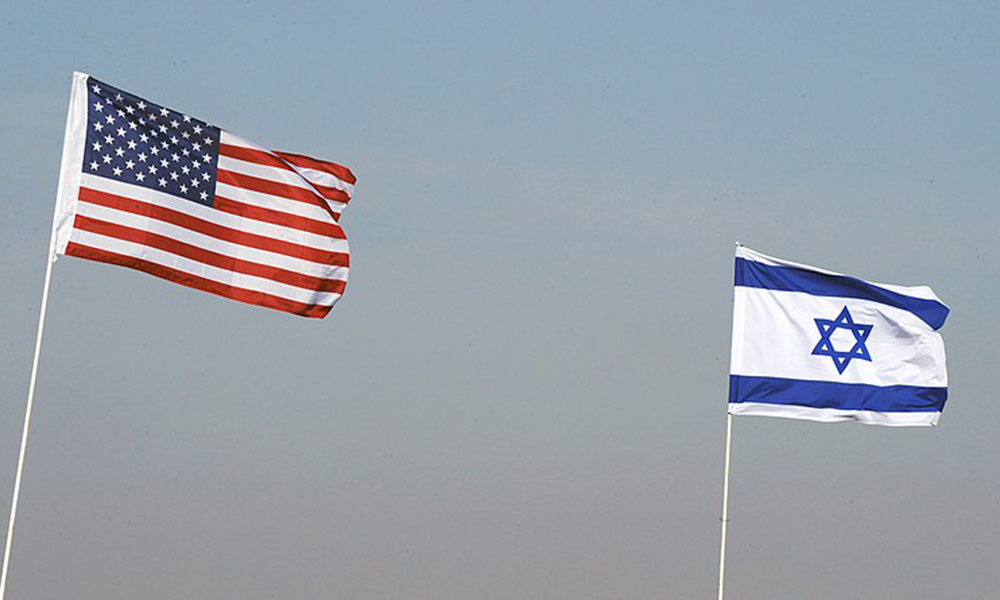
Opening picture: US-Israel Military Cooperation. Photo credit: Wikimedia Commons. Attribution-ShareAlike 3.0 Unported (CC BY-SA 3.0)
Moment Magazine participates in the Amazon Associates program and earns money from qualifying purchases.