
On the sixteenth day of the war, I found hope in an underground parking garage. I needed it, because the government of Israel—Benjamin Netanyahu’s government—was hopelessly dysfunctional.
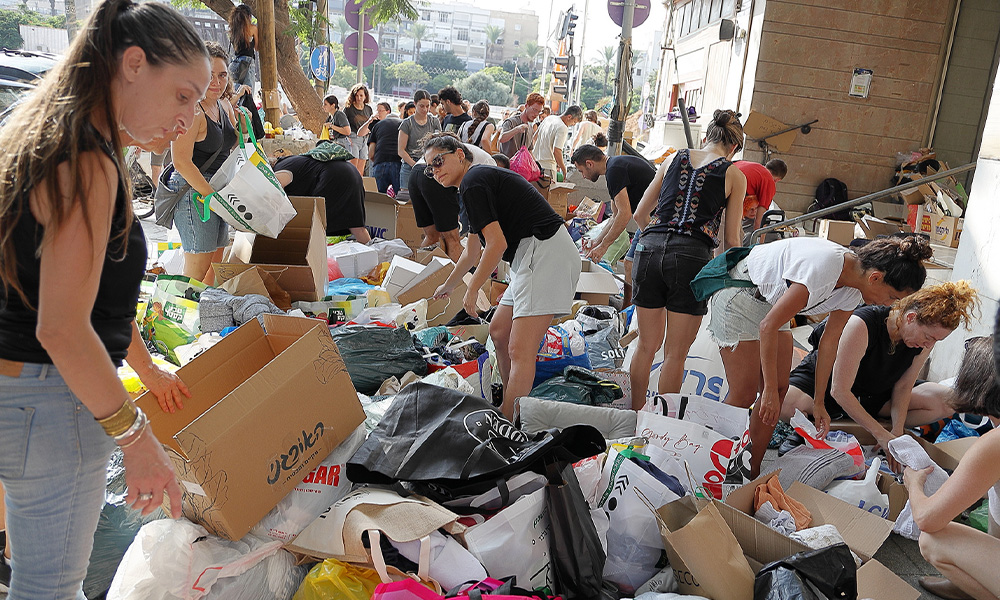
On one side of the immense garage, cars and trucks arrived with donations of food and clothes, shoes and furniture, and more. On the other side, drivers picked up deliveries to take to the north and south of Israel and to hotels where evacuees were staying. In between, hundreds of women and men were sorting and packing quickly in teams. On the concrete ceiling beams and on the floor were signs such as “Toiletries,” “Kitchenware,” “Feminine hygiene” and “Shoes—children.”
Many of the volunteers wore the olive-green T-shirts of “Brothers in Arms,” the protest movement of reservists opposed to Netanyahu’s plans to end liberal democracy in Israel. The day the war began, that group and others in the pro-democracy coalition transformed themselves into a philanthropic effort that normally would take years to create. They put out a call to the half-million Israelis on their WhatsApp, Facebook and other networks, and by the first evening had 15,000 volunteers. They rented four buildings at the convention center with donations. The parking garage became their logistics center.


The first person I met was a 17-year-old named Ori. He was working at the section for assembling “shiva kits” of plastic chairs, hot-water urns, tea, coffee, biscuits and bottled water to send out to families in mourning so that they could receive guests. “The government left a huge vacuum,” Ori said. “We’re filling the vacuum.”
At a large area sectioned off with stacks of cardboard boxes, people sorted donated shoes by size, type and gender. Families fled with nothing, a volunteer explained, they need everything.
At the emotional first-aid area, I met an 86-year-old psychologist. “It’s like the emergency room,” he said. “We check symptoms. We make sure they don’t feel alone. The serious cases we send to hospitals.” A couple evacuated from the south was talking to another volunteer. Their small children were busy with paint and a huge sheet of paper.
Nearby, in the cubicles and lounge of a large shared-workspace building, people with laptops worked in small groups, organizing everything. They looked like techies at a new start-up on deadline. An organizational table filled a wall-sized screen. Somewhere, in a cubicle, were the people who’d invented software to identify Israeli captives spotted in video clips.
I am not satisfied with this description. It cannot convey the intensity—the absurd, inspired efficiency—of an organization created out of nothing. It does not include the network of such volunteer efforts that sprang up throughout Israel—gray-haired ex-officers working in the fields of battle-blasted kibbutzim near Gaza to save crops; protest groups and the New Israel Fund paying for hotel rooms for families that fled Ofakim, near Gaza; volunteer teachers in the lobbies of hotels, teaching evacuated children.
And each story tells you something about what Netanyahu’s government has done: much too little. Before October 7, the government was consumed with passing laws to give itself unlimited power. It paid too little attention to national security and left Israel unprepared for the Hamas attack.
After the attack, each day’s news brought reports of an out-of-touch government. Reserve units, mobilized for war, lacked crucial equipment. Netanyahu’s relations with his defense minister and top generals were reportedly distrustful, disrupting war planning. Ministers squabbled over home-front programs. The mayor of Ashkelon, a city pounded by missiles, had to come to the Knesset to beg for relief funding. The mayor of Netivot, another ravaged town—a member of Netanyahu’s Likud Party—said the prime minister had “abandoned [the city’s] residents to their fate.”
What does this picture of Israel mean?
First, this is not only the most extreme government the country has ever had but also the least qualified. Netanyahu and his members failed to prevent the crisis, and they failed to rise to the moment after it erupted.
Second, Israeli society has proved to be astoundingly resilient. Let down by leaders, citizens stepped in. The old spirit of commitment to us rather than me emerged. The most common coping mechanism has been to help.
Third, the network of pro-democracy protest organizations became the foundation of this effort. “All the people who were accused [by Netanyahu and his allies] of being leftists and traitors and destroying the country are doing this,” a balding 72-year-old volunteer wearing a Brothers in Arms T-shirt at the logistics center told me. This makes perfect sense, because patriotism—a passion to save Israel—is what drove the protest movement. And finally, philanthropy isn’t enough. People who shied away from electoral politics will need to rethink. Israel needs new leaders. Volunteers, anyone?
Gershom Gorenberg’s latest book is War of Shadows: Codebreakers, Spies, and the Secret Struggle to Drive the Nazis from the Middle East.