
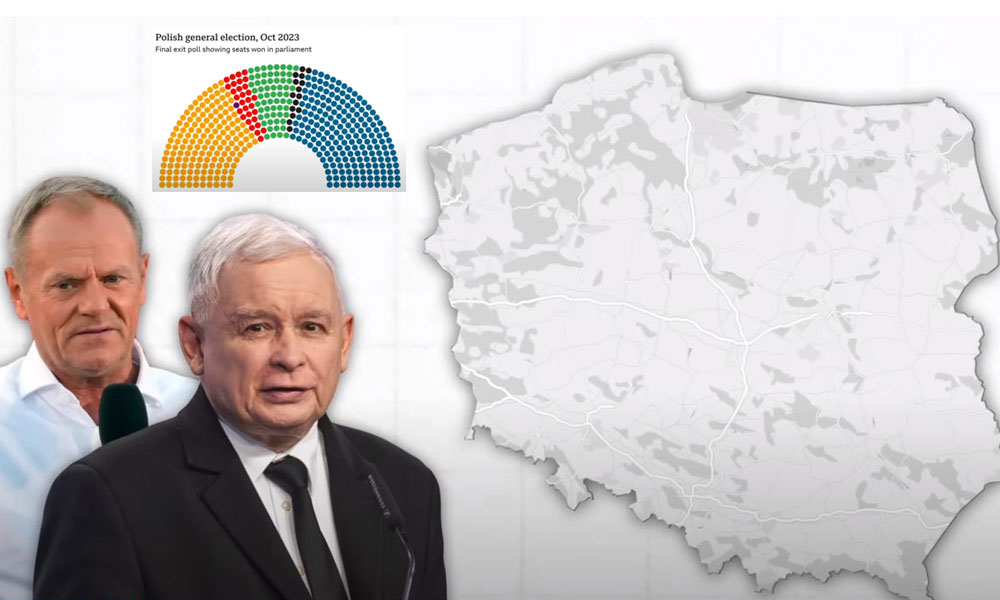
Poland has a long tradition of bucking political trends. When the Berlin Wall came down in Germany in the autumn of 1989, there already had been a non-Communist prime minister in power in Warsaw for three months. Yet Poland was also the first post-Communist country to vote the Communists back into office in 1995, when the former opposition made a mess of things. In 2005, Poland was admittedly the third country, after Slovakia and Hungary, to vote nationalist populists in—but it then dumped them in disgust in early elections barely two years later.
Those dumped neo-populists (who included some former Communists) then made one more comeback. The right-wing Law and Justice Party (PiS) governed for eight long years—only to lose general elections this October to a centrist-progressive coalition.


How did Poland buck the rightward trend that has crept through Europe and restore liberals to power? And does its experience offer any useful lessons? The PiS had triumphed in 2015, carrying both the parliament and the presidency, after a campaign in which it alleged, somewhat implausibly, that “the country is in ruins” and that it was simultaneously threatened by a European Union-inspired invasion of illegal aliens. In fact, EU membership had boosted Poland’s economy, and all Brussels wanted was for Poland to show some solidarity with other member states struggling with the migratory influx. But Poles still lagged behind the EU average on prosperity (hence the accusation of “ruins”) and this made them resentful and blunted their solidarity with others. Meanness can be a political driving force. (A divided left also played a role, along with fatigue after eight years of liberal rule.)
Even the opposition was surprised at its own success.
Once in power, the right-wing Law and Justice party launched an all-out, and largely successful, attack on independent media and the judiciary. It also engaged in serious social redistribution programs, lowering the retirement age and very generously increasing child benefits. This was accompanied by a massive crony takeover of crucial state economic assets and corrupt procurement: During the pandemic, stories about nonfunctioning respirators bought for exorbitant prices from a UN-blacklisted arms dealer, and useless face masks bought on the recommendation of the health minister’s skiing instructor, made headlines in the few remaining independent media. “They steal—but they share” was the collective opinion of a contented electorate. PiS handily won its first parliamentary reelection in 2019—though the next year Andrzej Duda, its president, barely scraped through.
And then, suddenly, tricks in the old bag turned stale. A series of pedophile scandals in the Church exposed the late John Paul II’s willful ignorance of the outrages—and the PiS campaign to “defend the good name of the Polish Pope” fell flat. Abortion was practically banned, pleasing the Church and conservatives—but hundreds of thousands of angry young people protested in the streets and turned against the PiS. Militaristic chest-thumping played well in a country traumatized by the war in Ukraine—but was exposed as a fraud when Russian rockets and Belarusian helicopters flew in Polish airspace undetected. Solidarity with Ukrainians—Poles took in two million, housing them mainly in their cramped flats—was wasted when, for petty political reasons, the government called Kyiv “ungrateful” and threatened to cut support. And the ongoing anti-immigrant hysteria directed at non-European migrants blew up in the government’s face when it was discovered that foreign ministry officials had been illegally selling thousands of Polish visas—from New Delhi to Kampala. Throw in double-digit inflation, and it was obvious that the government was done for.
Still, its demise was spectacular. With a 74 percent turnout, the highest in Polish history, the opposition coalition of liberals, Catholic conservatives, peasants and the left won a solid majority of seats in Parliament and two-thirds of the Senate, even though the PiS, with 36 percent of the vote, remains the biggest party. It still controls the presidency, the National Bank and—in violation of the Constitution—the Supreme Court and the Constitutional Tribunal, as well as state broadcast media. These institutions can effectively block the new government’s reforms—and this could go down badly with an electorate clamoring for rapid and radical change.
In the end, even the opposition coaltion was somewhat surprised at its own success. Now it needs to show that—as in the toppling of Communism in 1989—it can find common ground by restoring accountability, rule of law and elementary decency to government. The EU, which PiS openly considered an “enemy,” will be relieved to see the country back on track—and will liberate funds frozen in a conflict over alleged violations of EU rule-of-law standards. Washington will also be pleased to see Warsaw return to a consistent pro-Ukrainian course, and there is even hope for an end to conflicts with Jerusalem over Polish-Jewish history. The hard work, of course, remains to be done. But Poland has shown it is willing.
Konstanty Gebert is a journalist and author in Warsaw, Poland.