
Since January 20, when Trump-Musk, Inc. began to demolish the life-saving programs and humanistic advances of the last hundred years, progressives have been lamenting, “What can we do? How can we stop this?” The obvious answer is, Ramp up our political engagement: Register new Democratic voters. Volunteer to work at the polls. Hold politicians’ feet to the fire. Lobby our legislators. Post comments online. Start our own Substacks. Donate as much as we can to candidates of substance—ideally charismatic visionaries who can lead us into the light.
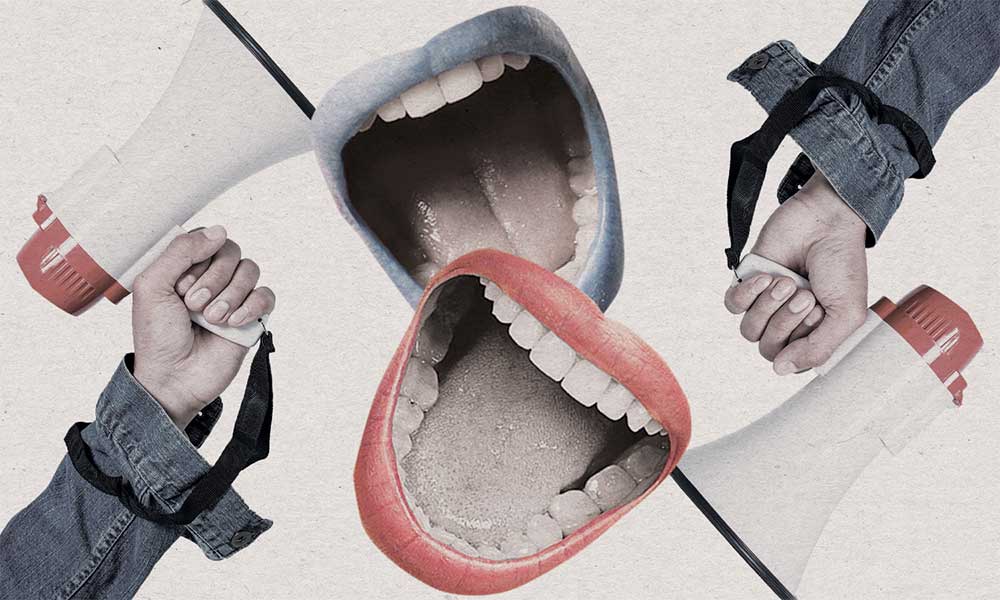
The less obvious answer is, Keep talking back. Civil confrontation is one of the most potent forms of political resistance.
Talking back means not letting a neighbor get away with a caustic comment about Jews and money. Nipping a cousin’s latest conspiracy theory in the bud. Not letting frustration or hopelessness paralyze our vocal cords.
As a political modality, talking back gets scant attention until someone famous does it. Alicia Keys didn’t just say thank you when she accepted her award at the Grammys. “This is not the time to shut down the diversity of voices we’ve seen on this stage,” she said. “DEI is not a threat, it’s a gift. The more voices, the more powerful the sound.” Likewise, Chris Kluwe, a former NFL football player, talked back to the Huntington Beach, CA, City Council about its plan to put a plaque extolling MAGA on the wall of the public library. “MAGA is explicitly a Nazi movement,” Kluwe declared, drawing applause.
We’re not all boldfaced names, though, and it takes a special kind of chutzpah to criticize a family member, friend or neighbor in private life. Older parents don’t appreciate being called out by their kids for using a racist term. Men don’t expect to be scowled at or censured for telling a sexist joke. Gentiles can get testy when Jews explain why erecting a creche in the public square makes us feel “othered.”


Thanks to the feminist epiphanies that gobsmacked me more than 50 years ago, I find it impossible to ignore anti-woman slurs or sexist insults. In the 1990s, a friend gave a dinner party and put me next to a Nobel laureate whose research I’d drawn upon for one of my books. Whenever I asked him a question, the scientist directed his eyes and his answers to the men at the table. His dismissiveness was flagrant enough that other guests squirmed. I debated my options: turn my back on him and swallow the indignity, or talk back and ruin the party. I talked back. The scientist and his wife left in a huff. I apologized profusely to my host and the remaining guests, but they said the confrontation was “great theater.”
One Tuesday, during a weekly political discussion group I attend on Zoom—that day it was nine women, three men—one of the men referred to “the female president of Mexico,” meaning Claudia Sheinbaum. Unable to resist a teachable moment, I asked why her gender was relevant. Did he realize he was reinforcing the notion that a default president is male? Would he have called Emmanuel Macron the male president of France?
A productive interchange ensued. Two other women on the call volunteered their experiences with similar diminutions. The man said he understood. He apologized. Our discussion of tariffs and trade policy continued where it had left off.
“I’m not opening this gate unless you give me a smile.” A young friend of mine told me a security officer at her university greeted her with that line daily. To her, it felt like emotional blackmail, as if this man with the power to bar her from campus was entitled to dictate her behavior. Like millions before her, she was afraid to make a scene, so she smiled. But her slavish obedience haunted her, and one day she finally replied firmly, “Your behavior is unacceptable. Open the gate.” He opened it sheepishly, apologized, and hasn’t done it since.
A final anecdote: One Passover, I attended a seder whose leader went around the table asking everyone to name people who are as bitterly oppressed today as Jews were in Mitzrayim. Most answers were topical—Syrians living under Assad, incarcerated Black men—but one middle-aged man said, “45.” Later, I realized he meant Donald Trump, the 45th American president. The man was actually equating Biden’s treatment of his defeated opponent with our people’s 400 years of enslavement in Egypt. Had I understood, I would have challenged him loud and clear. I wish I had.
Whether we’re taken seriously or patronized, ignored or ridiculed, once we articulate our reactions they’re out there circulating in the cosmos, imprinted on our listeners’ psyches, recorded in the book of life. Talking back tells the world that we’re not indifferent to its fate; that passivity is not an option; that we steadfastly believe in human perfectibility and the possibility of political and social transformation. Just as a butterfly flapping its wings in the Amazon can alter the weather across the globe, what we say in response to wrongheadedness or wrongdoing can be seismic enough to discomfort the comfortable and change the most made-up of minds.
Letty Cottin Pogrebin is the author of 12 books, most recently Shanda: A Memoir of Shame and Secrecy.
One thought on “Opinion | What Did You Just Say to Me?”
As a college student I was in seminars with a dozen students (plus the professor) and 3/4 were male. They were not shy to speak up and said the dumbest things. I always wanted to speak up but was too unsure of myself. Of course the male professor didn’t notice the 3 girls who never spoke in his class. That stays with me to this day, 50 years later. I wish I had more chutzpah. What ended up happening was I got on a committee to hire a female professor in that dept and it actually happened. She came, she taught and I moved on.