
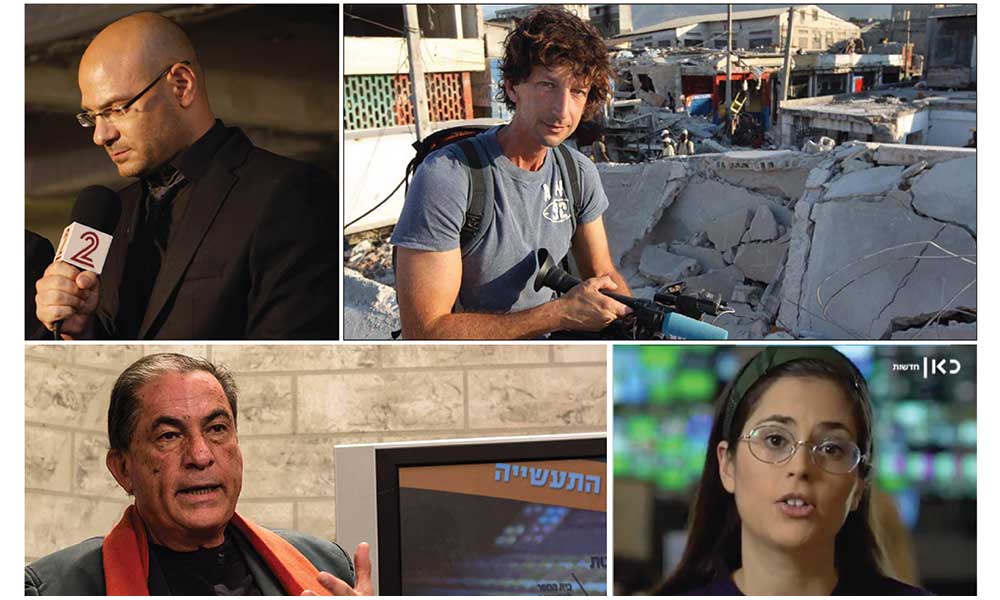
In Israel, Ohad Hemo is something akin to a rock star. A correspondent for Channel 12 News, Israel’s mostwatched television network, with some 340,000 people tuning in nightly, he reports live almost every night. People stop the 45-year-old in the street to shake his hand or take a selfie—even though his reporting makes some uncomfortable. As a Palestinian affairs correspondent, he gives his Jewish-Israeli viewers a glimpse of worlds they cannot—or will not—enter.
Take the bitter outbreak of war between Gaza and Israel in May 2021, when air-raid sirens sent thousands of Israelis across the country running for shelter, and 13 Israelis were killed by rockets fired deep into Israeli territory. The death toll was much higher in Gaza, where at least 256 Palestinians were killed. The dust had barely settled when Hemo drove south from his home in central Israel to farms near the Gaza border. Since the Israeli government bans Israeli citizens, including reporters, from entering Gaza, Hemo interviewed Gazans who were permitted to enter Israel for work. That night’s broadcast opened with Hemo walking through fields where Gazan workers were harvesting crops, asking these men in fluent Arabic about their experiences of the current conflict.
“My brother was killed,” Nabil, a Palestinian worker, told him.
“Your brother was killed by Israeli airstrikes,” Hemo asked, “and you’re here now, working with Israelis? Are you angry at Jews? At Israel?”
“No,” Nabil told Hemo, “my brother was killed by mistake—it wasn’t on purpose.”
For Israelis watching the 8 o’clock news from the comfort of their living rooms, this is a conversation they would never have. Most Israeli Jews have little or no opportunity to participate in nuanced one-on-one conversations with their neighbors living in Gaza and the West Bank. Unlike previous generations, who were more likely to have daily encounters with one another, in the post-intifada era, Palestinians and Israeli Jews have gone through a process of “unknowing” one another. “The average Israeli teenager or Palestinian teenager—they know nothing about the other side,” says Hemo. “The only way you get to know something about each other is from the news and social media.” This has occured, in part, because few Palestinians can now enter Israel. At the same time, under the Oslo Accords signed in the 1990s, Israelis cannot enter the parts of the West Bank that are classified as Area A, meaning those under Palestinian Authority control. Israeli reporters with press cards, however, can and sometimes do access Area A.
It is not only the content but the style of Hemo’s reporting that resonates with television audiences. One of his trademark methods is confrontation. Hemo stands in front of the camera and argues with Palestinians; he presents the argument he knows his viewers hold, and then lets them hear the other side. One report he filed from the Shuafat refugee camp in East Jerusalem in 2021, in which he spoke with young men about the prospects of another intifada, is an example.
“I want to tell every Jew to go back to his own land,” a young Palestinian resident told Hemo.
“What do you mean go back to his own land?” Hemo responded. “This is his country just like it’s your country. You don’t accept that this is my country like it is yours?”
“No,” the young man replied. “If you want to come back here, come back here as a tourist.”
Hemo is very deliberate about this method. “An Israeli Jew does not have the chance to have that argument with Palestinians,” he says. “When I engage like that, I’m kind of the representative of all Israelis.”
Since he is a Jew and a self-described Zionist, Hemo’s reporting doesn’t appeal to everybody. Some view it as inherently biased toward Israel. At the same time, he’s been branded by some right-wing Israelis as “leftist,” meant as a pejorative that calls his loyalty to Israel into question. The comments on his Twitterfeedpaintafullerpicture—most are positive, but for every five or six compliments and “kol hakavods” (“good job”), there are those calling him a traitor and branding the Palestinians he features as terrorists.
In the greater scheme of Israeli media, there’s not much television coverage of Palestinians beyond the Green Line, the demarcation agreed upon by Israel and its neighbors in 1949. While all four major TV news outlets have reporters on the Palestinian beat (and one, KAN, has a team of eight journalists, including both Jews and Arabs, who also cover Arab affairs and Arab states), coverage has dropped since the breakdown of the peace process in the early 2000s, except in regard to security and military issues. “Palestinians are not portrayed much at all,” says Oren Persico of The Seventh Eye, an Israeli media outlet that covers and analyzes the Israeli press. “And when a Palestinian is portrayed in Israeli media, it’s usually because they attacked a Jew or a settler or soldier. But a lot of the time, even those instances get very little media attention.” When a story about Palestinians comes on, he says, Israelis change the channel.
As walls have grown higher and fences have grown smarter, the trust gap between Palestinians and Israelis has widened. In June 2021, the Palestinian Center for Policy and Survey Research, in conjunction with the School of Social and Policy Studies of Tel Aviv University, reported that Palestinian and Israeli public support for peace was at an alltime low, as was mutual trust. The report concluded that low levels of trust are the most important explanation for why both peoples have stopped having faith in peace.
That’s why some reporters, such as Hemo and KAN’s Palestinian affairs correspondent Nurit Yohanan, feel as if they are de facto diplomats. “We show a world that is very close geographically but kind of far away in the eyes of the Israeli public, so I think our job is to try to show that world—good, bad and everything,” says Yohanan. “Ignorance is never bliss,” she says, adding that apathy is a worse demon than vitriol.
The 29-year-old Yohanan has a completely different style from Hemo. She’s a soft-spoken Modern Orthodox woman who often wears a headscarf that could easily get her in trouble in the field if the Palestinians she’s trying to interview think she’s a settler. But her calm manner and matter-of-fact reporting style reverberate on the job and on-screen.
Palestinians and Israeli Jews have gone through a process of “unknowing” one another.”
Yohanan does what she does because she is convinced her reporting makes a difference—sometimes. Last year, she filed a story that broke through the apathy barrier to shock Israeli audiences. She’d received a tip about a road in the West Bank where Palestinian workers were being accidentally hit by cars in the early hours of the morning, when it was still dark, as they illegally breached the Israeli security barrier to enter Israel for work. For many Jewish Israelis, Yohanan says, Palestinian construction workers are shadows in the backdrop of their lives—only glimpsed on the sides of roads or at construction sites. This underclass includes about 100,000 Palestinians working legally in Israel and approximately 30,000 to 40,000 additional Palestinians working without permits, according to the United Nations International Labor Organization’s 2021 estimates.
Yohanan arrived at a cramped checkpoint at 4 a.m. where, at the height of the pandemic, Palestinian men were pushing through the turnstile and the narrow gate of the crossing. Then she went to several locations where Palestinians had found holes in the fence. She followed them to the highway and interviewed them in Arabic, which she speaks fluently. The men told her they were so desperate to cross into Israel for work that they were willing to risk getting caught by Israeli authorities or being hit by cars on a dark highway.
After her report aired, she was shocked by how many Israelis reached out to her. “There were a lot of people surprised at how horrible the situation is, and that impacted their thoughts about Palestinian workers,” she says. “And that was the point—to show something and try to make people think and change their perspective or widen their perspective about the whole issue.” Most Jewish Israelis today don’t think about what life is like for Palestinian workers, she says. “And even if they do, they aren’t usually aware that these are the conditions they live under and that those conditions haven’t changed for 15 years.”
Hemo also believes that his work can move the needle. When he received the most prestigious award for Israeli journalism in 2020, the Sokolov Prize, he said: “There aren’t a lot of jobs where you can impact the fate of others, but here I found that job.” After the series of reports he produced on the dangerous and crowded conditions for Palestinians crossing through two West Bank checkpoints aired, Israel spent 300 million shekels ($85 million) renovating them, and he thinks his reporting on the issue had something to do with it. “That changed the lives of tens of thousands of people,” he says. “They got their dignity back.”
There’s an expression in Hebrew that translates roughly as: “An optimist is just a pessimist without experience.” While some of the new generation of Palestinian affairs correspondents are convinced their reporting can affect Israeli public opinion—or at least increase public awareness—other journalists who have worked this beat for decades see things moving in the opposite direction.
Gideon Levy has been covering Palestinian affairs for the left-wing Israeli newspaper Haaretz since the 1980s. A legend in Israeli reporting, he received the Sokolov Prize the same year as Hemo, in the print category, but his acceptance speech had a completely different tone. “I love my work, every moment of it,” Levy said upon receiving the award, “but has it translated into minor changes that I caused? Not at all.”
Levy, 69, attributes much of the difference in outlook between Hemo and himself to age. “It’s because he’s so much younger than I am. Look, I’ve covered the occupation really nonstop since 1987, when the first intifada began—30 to 35 years of at least weekly coverage.” He believes his ability to have an impact has decreased over time. He cites a feature he wrote in the late 1980s about a Palestinian woman from the West Bank who was in labor and, after being turned away at several checkpoints, ended up delivering the baby in her car and having to walk to the hospital in the rain. By the time she arrived, her baby had died.
The story caused outrage and the officer in charge was fired, but “since then I have published at least seven or eight similar stories, and they don’t have any effect anymore,” says Levy.
Ashraf al-Ajrami, a longtime opinion writer and a former minister of prisoner affairs for the Palestinian Authority, agrees with Levy’s assessment that coverage of Palestinian issues doesn’t swing public opinion. “The Israeli public is affected by the discourse of the government, especially the right-wing discourse, and nothing can be done to change this discourse,” says al-Ajrami, adding that Israeli reporters tend to follow the narrative of the Israeli authorities. “There is a gap between what happens in reality and what the Israeli journalists cover and report in the Israeli media,” he says.
“From the Palestinian perspective, there are fears that Israeli reporters will misrepresent them in the press”
Veteran reporter Itai Anghel, an award-winning television correspondent and documentary filmmaker, points out that it’s long been complicated for Jewish-Israeli reporters to cover the Palestinian world. Anghel, who produces 60 Minutes-style documentaries, was the only Israeli reporter to cover the late Palestinian leader Yasser Arafat’s funeral in Ramallah in the West Bank in 2004. His friends and producers thought he was crazy for going, but it is still one of Anghel’s most-viewed reports. “Before the broadcast, there was sort of a recommendation on behalf of the security apparatus in Israel not to go to this funeral, because there were intentions to hurt Israeli journalists,” Anghel says. “But since I’d been covering Palestinians, and some of them were my friends, I realized that it was an exaggeration.”
In the report, the camera follows Anghel as he wends his way through the masses of Palestinians who have flocked from their homes in towns and villages to pay homage to Arafat. He interviews mourners in Hebrew: “I made it clear to those I was talking to that, hey, I’m an Israeli, and I speak Hebrew. And I would love it if you speak Hebrew as well,” he says, explaining that he wanted to convey to Jewish-Israeli viewers at home that Palestinians should not be feared.
At one point he flips the camera to show Palestinian mourners helping his Jewish-Israeli cameraman climb onto a nearby wall so he can capture the full scope of the crowd from above. “Nobody is hurting you here,” one Palestinian tells Anghel in Hebrew.
“The usual reaction to my coverage is ‘We’re afraid for your life’ and ‘They could kill you any moment,’” says Anghel. “Some people have these stereotypes, unfortunately, that anyone beyond our borders is a pure enemy. So, for most of my life as a journalist, I have tried to show people how things really look from within, because I’m one of the very few who go there.”
Like Hemo, the 54-year-old Anghel used to go into Gaza, sometimes weekly, to show the reality on the ground. This changed in the wake of the 2006 kidnapping of Israeli soldier Gilad Shalit, when Israel banned citizens, even dual citizens who hold another passport, from entering the coastal enclave. Stories from Gaza are told by major foreign media outlets, including the Associated Press, Al Jazeera and Agence France-Presse, which have permanent bureaus there, but Israelis rarely consume foreign press sources or trust them to produce even-handed reporting. “There will be a very tiny minority that listens to the BBC,” says Anghel, but for the most part “foreign media to Israelis is not relevant.” The result is an Israeli public that remains in the dark about the dire humanitarian situation at its doorstep. That means Israelis go to the polls vaguely aware that their votes impact Gazans but with no information that they view as credible about what is happening in Gaza, he says. This is deeply concerning for seasoned reporters such as Anghel who watch the deteriorating situation from afar. “In Gaza, it is a nightmare. I have quite a few friends there and we keep in touch—unfortunately, they cannot speak freely anymore,” he says, referring to the retaliation Palestinians will face from Hamas if they speak with an Israeli outlet.
“Jewish Israelis rarely consume foreign press sources or trust them to produce even-handed reporting. “
Indeed, an increasingly daunting barrier Israeli reporters face today is the widespread push against “normalization” in Palestinian society—the idea that speaking with Israelis—even reporters—validates Israel’s existence. Many Palestinians now choose—or are pressured—to halt communication with Jewish Israelis altogether. “A lot of Palestinians don’t want to be interviewed by Israeli media, especially if it’s not about the occupation,” Yohanan says. She also says that Palestinians, particularly the younger generation, are afraid to speak with her for fear that the Palestinian Authority will arrest them for fraternizing with Israelis. Additionally, from the Palestinian perspective, there are fears that Israeli reporters will misrepresent them in the press.
Hemo pins the blame on both sides. “They say that bridges are the first things that get bombed during a war,” he says. “I think that in Israeli society, and in Palestinian society, there’s someone trying to bomb these bridges.”

Jewish Israelis also know little about their Arab neighbors inside the Green Line, even though they shop at the same supermarkets and malls, and work with them in businesses and hospitals. Arab citizens of Israel, some of whom identify as Palestinian, currently comprise about 18 percent of the population—21 percent if you include Jerusalem Arabs, who don’t hold Israeli citizenship but have a separate classification as Jerusalem residents. Hemo considers it part of his job to make Jewish Israelis care, or at least know, about their Arab counterparts. His latest project, Being an Arab in Israel, a five-part docuseries filmed entirely inside the Green Line, features Hemo tagging along with several Arab citizens and documenting their daily lives. One episode opens on Israel’s Remembrance Day, which commemorates Israeli soldiers who died in service to the state. Hemo accompanies an Arab lawyer in Haifa named Aliye on her way to work in an office full of Jewish Israelis. It is the first time Aliye stands for the Remembrance Day siren, which she does out of respect for her Jewish colleagues. But at a certain point in the Remembrance Day episode, Aliye comments that she doesn’t think Jewish Israelis would be eager to show her people, Palestinians, the same respect. The camera captures her complicated struggle to perform this act of remembrance for soldiers whom she views as occupiers.
In the series, Hemo appears in between the scenes onstage in an auditorium full of Jewish Israelis, presenting facts about Arabs in Israel, such as how much they earn annually as compared to their Jewish counterparts. The camera often pans to the looks of shock on the faces of people in the audience when Hemo presents data about the inequities.
At a time when public opinion in Israel is more polarized than ever, Hemo believes the series helps counter divisions, even in the depths of ongoing conflict. “I have never gotten so many responses from the Israeli public,” he says. “It was an unbelievable thing to viewers—the fact that these guys are living among us, between us.”
This interest is reflected in hard data collected by The Seventh Eye’s Oren Persico, which shows that Israelis, in contrast to their declining interest in Palestinians in the West Bank and Gaza, increasingly want to learn, hear and read about Arab citizens of Israel. Until 2021, he says, Palestinian citizens of Israel made up only about 4 percent of interviewees on mainstream Israeli television and radio stations. On Hemo’s Channel 12, that number was even lower, Persico says.
In 2021, however, The Seventh Eye tracked a major shift, with more Arab faces and voices in mainstream Israeli media and “a huge increase in the number of Palestinian interviewees on mainstream television,” says Persico. “It’s the best year since we started monitoring in 2016.” That has to do in part, he explains, with the increased visibility of Arab member of Knesset Mansour Abbas and his role in the governing coalition that collapsed this past June. It’s also due to the riots that swept through the country’s mixed Arab-Jewish cities, such as Haifa and Lod, during the military escalation in May 2021. But while the increase in Arab voices is encouraging, says Persico, progress is slow. On political talk shows, for example, just 0.9 percent of interviewees in previous years were Arabs. This year, he says, one political talk show managed to be the third best in overall Arab representation, with Arabs making up 7 percent of interviewees.
The numbers are small, but Hemo remains upbeat. He says the uptick shows that more Jewish Israelis are stopping to listen and becoming more aware of the issues Arab communities face across Israel, including skyrocketing crime rates, housing crises, poverty and lack of infrastructure. Still, with coverage of the West Bank growing more difficult and Gaza off limits for the foreseeable future, covering a wider breadth of Palestinian life—and providing a fuller picture of the ongoing conflict between two peoples—won’t get easier anytime soon.
Emily Rose is a correspondent for Reuters in Jerusalem.
This story was made possible by the J Zel Lurie Family Fund.
Top photo, clockwise from top left: Israeli reporters Ohad Hemo, Itai Anghel, Nurit Yohanan and Gideon Levy. Credits: Zaher Abu Elnaser via Wikimedia (CC BY-SA 4.0) (cropped) / Courtesy of Itai Anghel / Facebook screenshot/ Flavio Grynszpan via Flickr (CC BY-NC 2.0)