
We want to hear from you. To join the conversation, send a letter to editor@dev.momentmag.com.
THE BIG QUESTION
AMERICAN JEWS’ ROLE IN ISRAEL
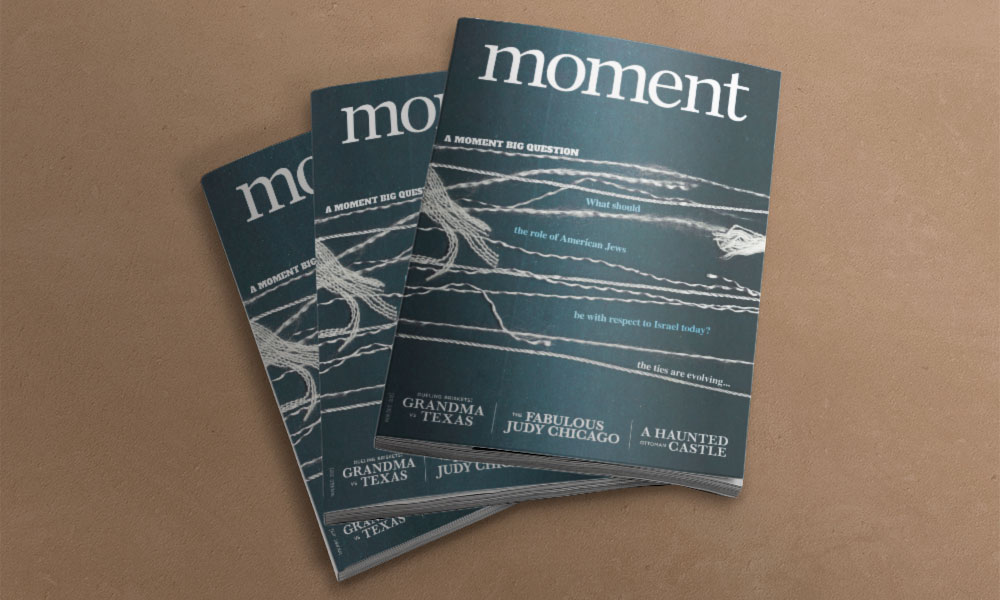
Susie Linfield was by far my favorite contributor to the issue’s Big Question (“What Should the Role of American Jews Be With Respect to Israel Today?”
November/December 2021). She had original and important observations to make. On the other end of the spectrum, we have Alina Jacobs, who had much more concern with Palestinians than with Jews—American or Israeli. And then there was Peter Beinart. How did such an intelligent man, a man whose writing I used to hunger to read, become so, well, silly? His yearning for justice is understandable, but might we have some practical suggestions on how two peoples who’ve been at war for 150 years will suddenly morph into Belgium?
Lawrence Jurrist
Hollywood, FL
A LIVELY GREAT READ
Some of the opinions in response to this “Big Question” prompted me to enthusiastically embrace this issue of Moment. Others made me want to toss the issue in the trash! Hence, a lively, provocative and balanced presentation that made for a great read. The topic is particularly important in these chaotic times because of its
far-reaching effects. Thanks for taking it on.
Michael Alan Finn
Washington, DC
A DIFFICULT QUESTION
Thank you for this important “Big Question.” This is a difficult question for me as someone who is in the process of converting to Judaism. (I’ve approached a Reconstructionist rabbi to guide my conversion, so I know I won’t have the right of aliyah anyway.) I disagree with a lot of decisions made by the State of Israel, but I do feel good that Jewish friends would have a place to go if things got really bad here in the United States. One thing I wish American Jews would do is listen more to the Israeli Jews and Arabs working toward peaceful relations rather than trying to impose their opinions on a nation with a very different reality.
Yossi Casteel
Houston, TX
LOST AND CONFUSED
We Jews have always found laughter and strength in the belief of “two Jews, three opinions.” For those who study Talmud, we often hear that “the question is more important than the answer.” In struggling to apply these worn-out adages to everybody’s words of wisdom in this article, I’m totally lost, confused and worried.
I’m only left with my own questions. It’s very safe to play out all these opinions on a page, but could all these influential Jews be gathered into a room to see each other’s humanity, even with all their different opinions? Could they hear each other out and then attempt to respectfully organize together for intelligent interaction and somehow move the Jewish world forward? Would they feel connected to one another? If the answer is no, then what does it mean to be “a people” or “a family”?
Gary Wexler
Valley Village, CA
HOLDING OUT HOPE
I am an ordinary American citizen and a Zionist of sorts. My love and support of the United States of America and of Israel remain undaunted and hopeful. Politically, I consider myself a moderate thinker. Usually, I can appreciate both sides of the same topic. I have been a loyal and supportive member of Hadassah for more than 60 years. Israel deserves to be respected in the community of nations. In spite of what is politically happening in our country presently, I wouldn’t give up hope that things will improve, maybe not in my lifetime—I am 88 years old—but certainly in my grandchildren’s or great-grandchildren’s (ages nine and ten). American Jews and the country of Israel—Jews and Arabs—can do it.
Vida Gaffin
Burlington, NJ

AMBIVALENT ZIONISM
I am so ambivalent here. I’ve had to split my love of Israel from my contempt for her government. It hurts. I cannot reconcile my vision of Israel as a place where Jews can go to be safe as Jews with what is becoming a theocracy, where extremists decide who is a Jew and whether an American convert is legitimately Jewish—even if she was converted by an Orthodox rabbi. I can’t accept that Palestinians are treated badly and ghettoized the way we were in the Middle Ages; I cannot accept that Jewish women who wish to worship at the Wall are corralled into a pen.
I am so ambivalent here. I’ve had to split my love of Israel from my contempt for her government. It hurts.
Israel could be so wonderful if she were true to her promise. But I’m here, not there. I have a dim notion of what it means to be scared for your life of terror attacks. I don’t like Likud sucking up to Republicans and Republicans sucking up to Likud to make them seem more acceptable to American Jews. My role is to love Israel and to tell the truth as I see it. It’s an opinion and I can only humbly offer it.
Karen Silver via momentmag.com
THE KHAN OF AJJUR
AN EVOCATIVE TALE
This was a most captivating and moving article (“The Ghosts of the Khan of Ajjur,” November/December 2021). Moreover, I have a personal connection to it. I worked with Itzhak Taragan for many years at Israel Radio (Kol Israel). And in 1967, before the Six-Day War, we trained in the area, in the abandoned houses in Ajjur, as part of our house-to-house combat exercises when I was in the 50th battalion of the paratrooper brigade. Ever since, I have tried to pass by the place, but the “Khan” I don’t recall. Perhaps I “conquered” it in one of the exercises? Keep writing evocative articles.
Arie Gus
Haifa, Israel
ASK THE RABBIS
VACCINATIONS ARE MITZVAHS
As a psychiatrist and medical ethicist, I found the rabbis’ discussion of vaccination refusal helpful and illuminating (“How Do You Deal With People in Your Community Who Don’t Want to Get Vaccinated?” November/December 2021). Most of the comments rightly emphasized the need to understand a person’s reasons for refusing to get vaccinated against COVID-19 and to refrain from shaming or shunning those who refuse this lifesaving intervention.
Two of the esteemed rabbis cited Deuteronomy 30:19 (“…therefore choose life”) as the central command of the Torah, and as a biblical rationale for getting vaccinated. I was surprised, however, that the principles of pikuach nefesh (preserving life) and shmirat haguf (protecting the body) did not receive more discussion. Vaccination against COVID not only preserves one’s own life during this deadly pandemic, it also helps preserve the lives of others by reducing transmission of the virus. And as Maimonides taught us, “Bodily health and well-being are part of the path to God, for it is impossible to understand or have any knowledge of the Creator when one is sick.
Therefore one must avoid anything that may harm the body, and one must cultivate healthful habits” (Hilchos De’os 4:1).
In sum, for an ethically responsible Jew, getting vaccinated against COVID-19 is far more than a “personal choice.” It is really a mitzvah—one aimed at preserving life and protecting one’s physical health, the better to remain on the right path.
Ronald W. Pies
Lexington, MA
A COMMUNITY OBLIGATION
I disagree with Rabbi Gershon Winkler on this question. A person who does not get vaccinated may well cause another immunocompromised person to get the virus and die. As Jews, we have an obligation to our community.
George Steinberg-Caudill via Facebook
SICK AND TIRED
I totally agree with Rabbi Haim Ovadia’s response that vaccines should be mandatory. I am sick and tired of the anti-vax people who are totally ignorant of the history of medical science running the conversation.
Ruiz Herrera via momentmag.com
THE COMPLEXITY OF ‘TALMUDIC’
A FEMINIST TAKE
I completely agree with Adam Kirsch that Talmud study is “anything but a waste of time” (“The Hairsplitting Complexity of ‘Talmudic,’” November/December 2021). Especially for women and progressive Jews, the former excluded from the text by misogynist halachic rulings and the latter by the barrier of not understanding Aramaic.
But now, in the 21st century, those are empty excuses. Anyone can study Talmud online, where nobody knows a student’s gender. There are many places where women can study Talmud in the traditional fashion, in person with a study partner; there are even yeshivot for women.
Both women and progressive Jews especially should study Talmud. Women, because it’s a matter of power. If women don’t know how halacha was formulated and established, then they can’t challenge it or change it. For progressive Jews, it’s learning that not all Talmudic arguments end with one winner whose ruling, often the strictest, defines halacha. Very often they end with teiku, which means that both views have merit and a person/community can follow either one.
Maggie Anton
Los Angeles, CA
A TALE OF TWO BRISKETS
THE BEST MEAT YOU CAN EAT
As a lover of brisket in all its forms, I enjoyed this piece very much (“A Tale of Two Briskets,” November/December 2021). I make braised brisket in a tomato and onion sauce with beer (except for Passover) and I also have a smoker that makes Texas-style brisket. Several times, the Reform temple in town has asked for smoked brisket for 80 to 100 people instead of the braised. The stronger smoke flavor overtakes the less savory braised, but both are some of the best meat you can eat when done right.
Jerry Newman
Sebastopol, CA