

This is an issue of the Antisemitism Project newsletter. To receive this vital resource in your inbox, please visit the Antisemitism Project website.

London Burning? Antisemitism in the UK
A recent spate of articles in major UK dailies have reported that Jews in Britain, and London specifically, view the environment as unsafe for Jews.
• In a March 5 Evening Standard cover story, Martin Bentham quoted polling from the Campaign Against Antisemitism. The CAA found that 48 percent of Jews living in Britain were considering moving abroad due to an increase in antisemitism. This, of course, follows the October 7 Hamas attack on Israel and the ensuing war in Gaza.
According to CAA—whose stated mission is to counter antisemitism through “education and zero-tolerance policies”—some have already made the move. When asked how many, a CAA communications officer pointed Moment to a February Jerusalem Post article citing statistics from Israel’s Ministry of Aliyah and Integration: “Since the beginning of the war, there had been a 300 percent increase in the opening of immigration case files in France, over 100 percent in the United States, 150 percent in Canada, and 40 percent in the United Kingdom.”
• On March 4, The Independent’s Athena Stavrou shared stories of UK citizens who had experienced antisemitic aggression. Jack Christie, 25, said he’d never felt threatened by antisemitism until November, when a man spat racial slurs and threatened to assault him while he was riding a train home from a march—against antisemitism. A 47-year-old woman, Sharon, who didn’t feel comfortable sharing her last name for the story, said she was aggressively questioned when she tried hanging up hostage posters in east London. When she took out her phone to record the incident, she was pushed to the ground and her phone was smashed. In another instance, Sharon questioned a woman who was tearing down posters of Israeli hostages, and the woman started shouting at her, accusing Sharon of being a baby killer. Christie was accused of the same on the train.
“I feel like I have to put another lock on the door because Britain feels like Nazi Germany,” Sharon said. “Everybody’s thinking about leaving and having conversations with friends about whether to stay or not.” She says she’s definitely not. “There’s no room for people like me in London.”
• According to the Community Security Trust, a nonprofit dedicated to improving the Jewish experience in British society and combating antisemitism, there were 4,103 antisemitic incidents reported in the UK in 2023 (a 147 percent increase from 2022). Two-thirds of those incidents occurred after October 7 and a little more than half—2,140—happened in London. (923 antisemitic incidents were reported in London in 2022.)
The head of CAA, Gideon Falter, told The Standard that many British Jews are afraid to display their Jewish identity in public because of the rise. “Jewish children are being told to hide their school blazers, Jewish students are being terrorized on campus, synagogues are guarded, kosher shops are being attacked, business owners are being threatened.”
• Much of the fear in London concerns the large public protests against Israel’s war in Gaza, which some British Jews allege show support for Hamas and its actions. CAA’s polling data shows 90 percent of Jews have avoided the city center at times when there was a major anti-Israel demonstration happening. Suggesting a curb on such events, the UK government’s counter-extremism commissioner, Robin Simcox, told BBC News that if “London is no longer permitted to be turned into a no-go zone for Jews every weekend,” it doesn’t mean the city has become “an authoritarian state.”
• However, not all Jews living in London see the city as going down a dark path. Writing for the Israel-based +972 Magazine, Ben Reiff alleges that the British government has been in cahoots with the media to incite a moral panic regarding pro-Palestinian demonstrations in order to silence the voices of protesters calling for a cease-fire in Gaza. While he acknowledges the uptick in antisemitic incidents following October 7, he points out that a third of the 4,103 incidents reported by the Community Security Trust were online. And he doesn’t connect the others to demonstrations—at which, he adds, quoting figures from openDemocracy, the arrest rates have been “lower than at a typical football match or the annual Glastonbury music festival.”
• Liam Hoare, Moment Europe editor, says that these protests have proceeded peacefully for the most part, but that many British Jews have been frustrated that the police have not handled the frequent demonstrations adequately and “have struggled to strike a balance between freedom of speech and assembly and prosecuting laws regarding hate speech.” While Hoare feels the term “no-go zones” isn’t helpful in framing the discussion, “what is undoubtedly true is that there was a dramatic spike in antisemitic incidents in Britain beginning on October 7 itself, indicating a clear relationship between the massacre of Jews in Israel and manifestations of Jew-hatred in Britain.” In his reporting, he’s spoken to Jews across Europe who he says feel angry, helpless, disturbed, traumatized, and even abandoned since October 7, and that British Jews are no exception. —Jaclyn Sersland
Interview | Franklin Foer on the Golden Age of American Jews
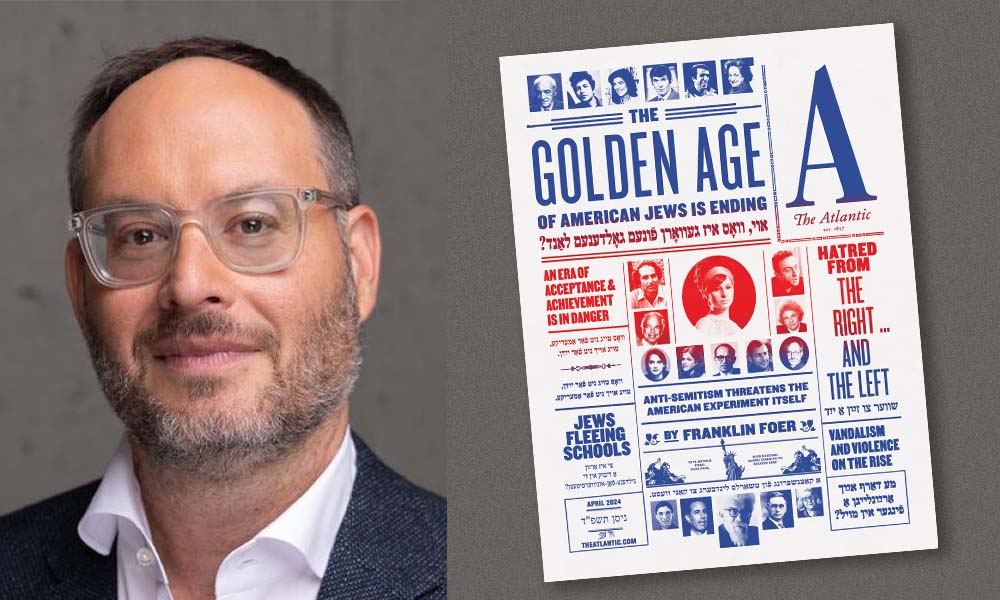
In “The Golden Age of American Jews Is Ending,” TheAtlantic’s April cover story, Foer details rising antisemitism from both the left and the right, and reflects on the end of a unique period in Jewish history, one in which a now-eroding liberal order afforded Jews unprecedented safety and prosperity.
Q: How did this piece come about?
A: About a year and a half ago, my brother Josh and I were talking about antisemitism in America. I said, I know it’s terrible. I know it’s rising. But I also said that I hadn’t actually experienced any antisemitism personally. He’s more observant than I am, and he started to tell me anecdotes from his life. He described one Shabbat walking down the street in Boston and being followed by somebody who was muttering “Trump, Trump, Trump” under their breath in a menacing sort of way, and about how his in-laws had a shtiebel [a storefront synagogue] in Westchester, NY, that had been shot up with a BB gun, and that his son’s friend, who is a Hasidic rabbi in Boston, had his house burnt in an antisemitic arson case. And I realized I needed to dig in and understand exactly what’s happening in the country. Things started to intervene, and I kept getting pushed onto other projects. And then October 7 happened, and I really couldn’t write about anything else.
…
Q: How would you respond to the idea that this so-called golden age is just part of a narrative cycle in Jewish history whereby things will be going okay for the Jews, but eventually they get kicked out?
A: So my piece isn’t “the end of American Jews,” it’s the end of the golden age of American Jews. And I don’t even think it’s the end-end of that. I’m not saying that Jews won’t continue to be influential, won’t continue to exist in a prosperous way. Jews are not going to disappear from American life. It’s just that there was this extraordinary moment where we overpopulated Ivy League universities, we overpopulated the cultural elite relative to our small size. And I think there’s a rebalancing that’s happened alongside the rise of this new sense of insecurity and unsafety that’s percolated up. But most of Jewish history involves Jews going about their lives, punctuated by episodes of antisemitism. And what was extraordinary about the post-World War II period was that there were very few of those punctuation points. There was very little reason to feel any sense of anxiety. And the opposite often occurred; being Jewish was a marker that you could wear proudly and might actually prove to be attractive to the Gentiles. That’s why, for example, Jerry Seinfeld didn’t need to obscure his Jewishness. He could play it up, confident that people were going to eat it up. And they did.
SELECT INCIDENTS
Canada, March 20
Playhouse Theatre in Hamilton, Ontario, says it’s postponing the April Jewish Film Festival in response to security threats because some Israeli films were to be shown.
France, March 14
Holocaust memorial in Paris suburb vandalized with pellet gun.
United States, March 13
Rideshare driver charged with hate crime for punching rider at San Francisco International Airport after asking him if he was Jewish or Israeli.
READ FULL ANTISEMITISM MONITOR REPORT
Over Half of College Students Feel Unsafe, New University of Chicago Survey Finds
Students want schools to condemn violence of all kinds
Due to the uptick in reported cases of antisemitism and Islamophobia on U.S. college campuses since October 7, the Chicago Project on Security and Threats (CPOST) at the University of Chicago administered a study to assess the effect of increased violence and disagreements among students. Their findings, published this month, are based on two national surveys of 5,000 college students from more than 600 universities. Surveys were conducted between December 14, 2023, and January 16, 2024. The main findings of this report were:
- 56% of Jewish students have felt personally endangered.
- 52% of Muslim students have felt personally endangered.
- 16% of other students have felt personally endangered.
Regarding the chant “From the River to the Sea, Palestine Will Be Free,” 66 percent of Jewish students find the expression to be antisemitic in nature—that it expresses the goal of a genocidal removal of Israeli Jews. However, only 14 percent of Muslim students interpret genocidal intent in the chant. When asked if calls for genocidal action against Jews should be permitted speech, and then asked if such calls against Muslims should be permitted, in both cases just 10 percent of all students surveyed said yes. The numbers were likewise identical when students were asked whether they agree with the statement: “When [Jews or Muslims] are violently attacked, it is because they deserve it”; in both cases 13 percent agreed.CPOST also found that students feel the most relief and optimism when their universities issue public statements that condemn violence of any kind; 52 percent of students agree that their colleges should make these statements, while only 13 percent disagree (35 percent had no opinion). A large majority of students (63 percent) agree that discussions should happen with other students and faculty to better understand differing opinions—while only 4 percent disagree.Specific statements from students included responses to queries about explicit danger and intimidation, such as:
- “Students at UVM will threaten to kill you and throw bricks through your apartment windows for hanging an Israeli flag in your window.”
- “I would feel I could suddenly be killed if someone recognized me from a protest I attended or maybe for wearing a keffiyeh.”
Statements concerning economic and academic consequences included:
- “Fear of losing scholarships or being kicked out of college due to my opinions on the conflict.”
The CPOST report concludes with six recommendations universities should adhere to in order to reduce students’ fears of personal danger. These involve clearly communicating the school’s position against violence on campus and raising awareness about how certain speech can be interpreted. Colleges are also recommended to conduct their own surveys—similar to this one—in order to properly track the threat of violence on their own campuses. Making protests safer with increased police presence and mental health resources for students in distress are also recommended.“Embracing these principles will require unprecedented levels of attention by senior leadership and funding,” the report concludes, “but they are justified by the magnitude and potential repetition of the problems that evoke them. There is no higher priority for national action and the mission of the university.” —Tyler Griff

Shifting Identities After 9/11 and October 7

SiriusXM radio host Dean Obeidallah (above, left) was born and raised in New Jersey, the son of a Palestinian-Muslim father and a Sicilian-American mother. His family assimilated into American society until the 9/11 terrorist attacks, when Arabs and Muslims throughout the United States suddenly faced raging Islamophobia. Now, 22 years later, many assimilated Jews are experiencing the same thing since the October 7 attack on Israel and the dramatic increase of antisemitism. Obeidallah, co-creator of the comedy show “Stand up for Peace,” which fosters understanding between Muslim and Jewish-Americans, and Max Brooks—author of the bestselling book World War Z and a nonresident fellow at West Point’s Modern War Institute—discuss how external events heighten tribal identity and how to respond to it.
Watch Here
What We’re Reading
Stories from around the Web
The New Yorker: “The Problem with Defining Antisemitism”
The New York Times: “Where Antisemitism and Anti-Zionism Collide”
and “What Is Antisemitism? A Columbia Task Force Would Rather Not Say.”
Resources
Key reports and studies on antisemitism around the globe