
What to Read: A Sampling of the Ways the World Ends
In this time of uncertainty, Moment is working hard to provide you with fact checked news, resources and analysis—plus some lighter fare—to help us make it through the crisis together. Click here for our ongoing coronavirus coverage.
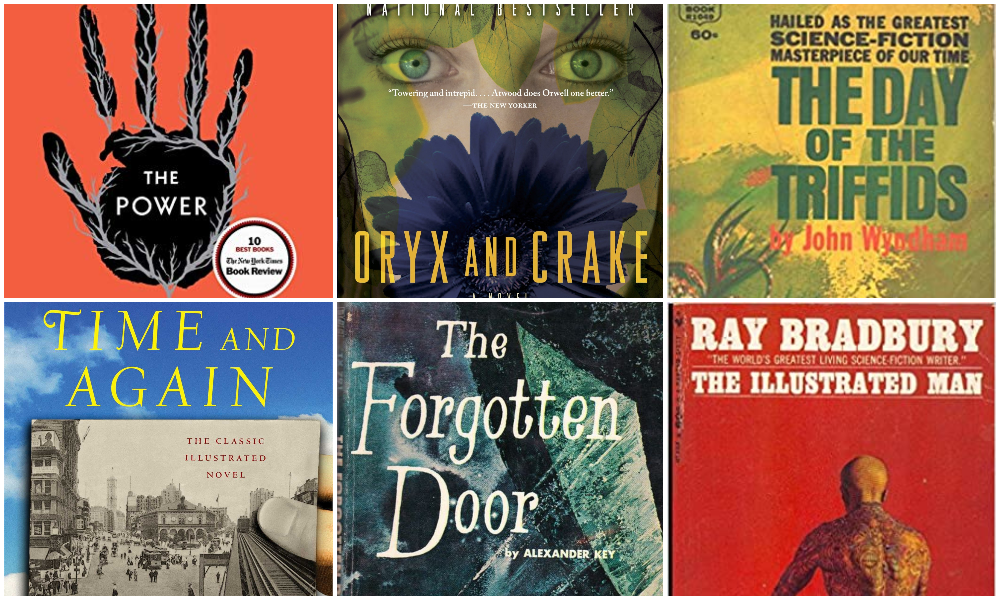
Something about watching civilization and its institutions collapse makes me nostalgic for the dystopian novels of my childhood. Cleaning out a bedroom for a returning college student, I came across an old copy of John Wyndham’s The Day of the Triffids, took it downstairs and settled in happily to scare myself to death.
The post-apocalyptic literature I grew up on largely assumed we’d end everything with a big, catastrophic war. The classics of the genre, from Stephen Vincent Benet’s novella By the Waters of Babylon (1937) to Russell Hoban’s Riddley Walker (1980), didn’t show you the destruction of civilization straight-on: They were set long afterward, when knowledge of the cataclysm has been lost along with memories of the old world and its technological wonders. Their narrators were simple farmers or hunter-gatherers, growing up among incomprehensible fragments. Philosophically, they embodied Albert Einstein’s possibly apocryphal comment, “I have no idea what weapons we’ll fight World War III with, but I know what weapons we’ll fight World War IV with—sticks and stones.”
These stories hold up pretty well to rereading, especially now. (You can find the Benet story easily online, though the author has fallen into unjust oblivion.) What dates them is the way these seemingly simple inheritors looked back on the lost civilization—once they came to understand it had existed—not with regret but with condescension and pity. Industrial civilization, in this reading, had died of its sins and was better off gone. Over the next 30 years or so, this impulse to recoil gradually intensified; by the 1960s it had merged into a general post-bomb, back-to-the-land, let’s-forget-the-whole-cursed-experiment vibe, aftershock of the despair that followed the Holocaust and Hiroshima.
In the space travel and time travel stories of that era, the protagonist from the present often ends up taking refuge in a simpler past. Sometimes he (usually he) is in retreat from the reader’s own time; sometimes it’s from a baleful future. In Jack Finney’s lovely Time and Again (1973), the narrator, an ad man who’s fallen in with a government project to change history through selective visits to the past, falls in love with a girl from the 1880s and ends up going to live there permanently, fleeing the knowledge of what happened in the 20th century and slamming the door on any possible return. (In the final scene, he prevents the parents of the time-travel scientist from meeting, ensuring that the inventor of the technology will never be born.) For kids, there’s Alexander Key’s The Forgotten Door (1965), in which a young traveler, Jon, turns up on Earth after falling through a disused portal from a faraway planet whose people once traveled freely through space, but gave it all up for agrarian simplicity. An American family shields Jon from the inevitable frenzy and persecution; in the end, they all flee together to his Eden.
Then there’s Ray Bradbury’s “The Fox and the Forest,” a short story in the classic collection The Illustrated Man (1951), which describes a future civilization (he specifies 2155) so horrific that when time travel is discovered, people flee to the past in droves. The panicked narrator’s description of that future stuck with me for years, and I still find it unsettling: “We lived in a world…that was like a great black ship pulling away from the shore of sanity and civilization.”
Next to that bleak vision, Benet’s narrator in By the Waters of Babylon, writing after World War I but before World War II, is forgiving, almost tender. His tribesman crosses the great river to the forbidden City of the Gods, the ruins of Manhattan: Probing its mysteries, he ultimately penetrates a sealed apartment, encounters a desiccated corpse and realizes with shocked pity that these were not gods at all: “They went a dark road, but they were men.”
You have to go back before that war for the most delicate and indirect of civilization-in-collapse portraits, Thomas Mann’s Death in Venice (1912). It’s especially frightening reading during a plague, particularly one that sometimes seems to be raging unattended. In Mann’s novella, the writer Aschenbach, who embodies high culture, finds himself gradually sinking into madness on a solitary vacation in Venice while all around him an invisible, hushed-up plague decimates the city. Mann was, of course, later witness to a culture succumbing to the contagion of Nazism and spent some years in exile in America as a result of seeing it clearly.
What about now? There is plenty of excellent collapse lit being written, of course, and today’s authors seem less likely to condemn what we’ve built and declare it better off gone. The first work a lot of us picked up in this crisis was Margaret Atwood’s Oryx and Crake trilogy, written between 2003 and 2013; even more topical than her Handmaid’s Tale, it looks steadily at both the state of society just before the collapse and the agony of losing it all. Before her “waterless flood,” cities have already been drowned by rising oceans, democracy is reduced to a thinly disguised corporate fascism, and creepy genetic innovations take the place of real progress. But the landscape after the bio-plague sweeps through is much, much worse, and its survivors long desperately for what is gone.
For more twists on social collapse, there’s the brand-new Second Sleep, by Robert Harris, who specializes in alternative histories (his Fatherland was set in a version of the 1960s where the Nazis had won World War II.) Or Naomi Alderman’s The Power (2016), about what happens when teenage girls develop the ability to electrocute men by touching them. Truthfully, there’s no shortage of ways things can end badly.
Triffids is still my favorite, maybe because it’s so wacky. One night, nearly the whole population of Earth turns out to watch a wondrous display of natural fireworks, apparently caused by debris from a comet’s tail—only to wake up the next morning stone-blind. The few survivors who managed to avoid seeing this display (including the narrator, who was in the hospital with his eyes bandaged) begin rebuilding society from ruins. But they fall prey to the triffids, products of a successful bioengineering breakthrough, who were created as a source of bio-oils but turn out instead to be intelligent, ambulatory, extremely hostile, stinging plants.
At this point Triffids swerves enjoyably into disaster-movie territory, kind of like Hitchcock’s The Birds, with stiff-upper-lip Englishmen holed up in country estates trying to hold off the vicious, carnivorous forests. Somehow, at least this week, that’s preferable to the literature that strikes so uncomfortably close to home. Honestly, if I’m going to have nightmares, I’d rather have them about being attacked by man-eating plants.
Moment Magazine participates in the Amazon Associates program and earns money from qualifying purchases.